lixe
Members
-
Joined
-
Last visited
-
I plan to do the same. Currently I have 3x4TB and want to replace them with 2x16TB. My plan would be as follows: 1. add a 16TB disk and configure it as second parity disk 2. remove the 4TB parity disk and use only the 16TB disk as parity 3. add the second 16TB disk to the array (preclear before, so that the parity disk stays in sync) 4. move all data from both 4TB disks to the new 16TB disk 5. finally shrink the array to remove the two 4TB disks Should that work?
-
Never mind, it works all at once... changing my network settings somehow made it work fine now.
-
I finally switched from macvlan to ipvlan. My VLAN networks (br0.x) are working fine. However, I can't get the br0 interface to work. I tried both through docker settings (switch macvlan to ipvlan) and with the command: docker network create -d ipvlan \ --subnet=x.y.z.0/24 \ --gateway=x.y.z.1 \ -o parent=br0 br0-net But when I start a container, I always get the error message "server error". The error persists even if I recreate the container. Since my br0 network is actually also a VLAN, but arrives untagged, I have now set it up as a VLAN and put the br0 interface on an "empty" PVID. The only problem with this solution is that I can no longer use containers that are configured as bridges. Anyone have any idea where the error could be?
-
Ich versuche derzeit auch meinen Stromverbrauch soweit wie möglich zu reduzieren. Ich habe ein ASRock H370m-ITX, Pentium G5400, 2x16GB RAM und RM550x. Angeschlossen sind 3 HDDs und eine SSD Meine CPU geht sogar auf C10/C1E, die IGPU geht ebenfalls auf RC6, nur Package State geht nicht über PC3 hinaus. Ich habe mehrere BIOS-Versionen versucht, diverse Einstellungen im BIOS hin und hergeschoben (vor allem alle C State Einträge auf enabled), beide Ethernet Anschlüsse getestet, aber es ändert sich nichts. Leider kann ich nicht nur einen der beiden Ethernet Anschlüsse deaktivieren (wird eh nur einer genutzt), wenn dann nur beide, aber auch das habe ich getestet und bleibe bei PC3. Ob Performance oder Power-Save beim CPU Governor ändert auch nix. powertop --auto-tune wurde natürlich auch durchgeführt. Selbst wenn ich alle Festplatten trenne und Ubuntu 22 vom Stick starte, kommt er leider nur bei PC3 an. Das einzige was ich noch testen kann, wäre den zweiten RAM Riegel zu entnehmen. Vermute aber das spart zwar ein bisschen was, wird aber wohl kaum für die PC States verantwortlich sein. Kann es sein, dass das Board einfach nicht mehr als PC3 zulässt? Immerhin komme ich so im Idle dennoch auf ca. 15 Watt, was schon mal ganz gut ist, aber eigentlich müsste ja mehr drin sein.
-
Just stumbled across this old solution to get wake-on-demand working, but sadly the python script isn't working for me. Already figured out the problem. The script won't get any discovered services. When running avahi-browse -a I'm also not able to see my unraid services (smb, ssh, sftp). But when I run avahi-browse on my raspberry pi, the unraid services are visible. So it seems they are getting published correctly, but my unraid server won't recognise them using the avahi-browse command, which is necessary for the python script to do its thing... But I have absolutely no idea what could cause this problem
-
Discovered this plugin a few minutes ago, works like a charm! (Pentium G5400 / UHD 610) Thank you so much!!! Just out of curiosity, why does the Overview list more available modes than actually available? Overview of available modes: i915-GVTg_V5_1: VMEM: <512MB, 2048MB>, up to 1920x1200 i915-GVTg_V5_2: VMEM: <256MB, 1024MB>, up to 1920x1200 i915-GVTg_V5_4: VMEM: <128MB, 512MB>, up to 1920x1200 i915-GVTg_V5_8: VMEM: <64MB, 384MB>, up to 1024x768 Following modes are available: i915-GVTg_V5_4 i915-GVTg_V5_8 (I guess, the UHD 610 only supports i915-GVTg_V5_4 and i915-GVTg_V5_8)
-
Does USB-passthrough work for anyone? At first I thought my VM crashed, when I switched from VNC to GPU-passthrough. But I noticed that the clock still worked in the system. So I switched back to VNC and I‘ve got the same problem. When using an external mouse and keyboard (USB-passthrough) both stop working after a couple of seconds, controlling using VNC still worked. Did only try Big Sur so far, will try Catalina today. I took a look at the logs and I always get something like this: „usb_device_descriptor 2 unknown type 33 (len 10)“ Google sadly wasn’t my friend. I would use a separate USB-card in my Unraid server, guess there wouldn’t be any problems, but I only have an ITX-board and the one PCI slot is needed for the GPU.
-
Did you try installing with VNC first and switching to passthrough afterwards? Not sure why, but a new VM only shows a flashing cursor, but my already installed vm does boot just fine.
-
Just wanted to give OpenCore in unraid a try, but I don‘t even get past the Tiano Core logo. My VM instantly restarts, only the size of the Tiano Core logo varies between small and large... So I mounted a copy of my clover.qcow2 and replaced the EFI folder with the one from github, I also created my own qcow2 file based on the instructions I‘ve found, but it always keeps rebooting instantly. Guess I‘m missing some basic instruction? Is there something else beside the EFI folder and some customization in the xml template? EDIT: had to change the scan policy 🙄 But the installation keeps starting in chinese even though I changed the prev-lang:kbd setting in the config.plist. I was able to change it then (google picture search helped me finding it), but I'm still curious. I also did a nvram reset using OpenCore just to be sure, that the modified setting gets loaded, but it starts in chinese no matter what I do...
-
I’ve tried that, but I always get the same error, when also using the sound card: internal error: qemu unexpectedly closed the monitor: 2020-03-31T12:19:09.054286Z qemu-system-x86_64: -device vfio-pci,host=0000:00:1f.3,id=hostdev1,bus=pci.0,addr=0x6: vfio 0000:00:1f.3: group 9 is not viable Please ensure all devices within the iommu_group are bound to their vfio bus driver. The iGPU alone seems to work so far. I did of course change the vfio-pci.ids entries, so that they match my gpu and sound card. My Windows 10 VM is set up as i440fx-4.0 and SeaBIOS. I’m using an H370M-ITX/ac board with a Pentium G5400 (UHD610). If also tried passing through the iGPU on my non-unRaid machine (using the trial and a spare disk), which has an Designare Z390 board and an i5-9600K (UHD630) and the same thing happens, iGPU alone would work, but as soon as I try to passthrough the sound card too, I get the same error. By the way group 9 looks like this on my unraid machine: IOMMU group 9:[8086:a304] 00:1f.0 ISA bridge: Intel Corporation H370 Chipset LPC/eSPI Controller (rev 10) [8086:a348] 00:1f.3 Audio device: Intel Corporation Cannon Lake PCH cAVS (rev 10) [8086:a323] 00:1f.4 SMBus: Intel Corporation Cannon Lake PCH SMBus Controller (rev 10) [8086:a324] 00:1f.5 Serial bus controller [0c80]: Intel Corporation Cannon Lake PCH SPI Controller (rev 10) [8086:15bc] 00:1f.6 Ethernet controller: Intel Corporation Ethernet Connection (7) I219-V (rev 10) On my Designare Z390 it’s pretty alike. So if someone has an idea how I could be able to pass through my sound card as well, I would be very glad EDIT: OUCH! Just after posting this I realized something... my unraid server was using the I219 eth which was of course in group 9. So I quickly changed the unraid eth connection to my second one, which is placed in a separate group and after that my sound card finally did work!!!
-
I just stumbled upon this problem, is there a way to fix this behaviour? I could move the whole data folder to cache only, but then the parity wouldn’t function as backup and storage would also be more limited... I’m thinking about one solution which I didnt try yet: Changing the /data folder to cache only, but also create a path for /data/USERNAME which points to a separate share which is array only. If I’m not mistaken Nextcloud then shouldn’t spin up the array after a simple login because the appdata_ folder is stored on the cache disk, but all my files stored in Nextcloud wouldn’t be stored on the cache anymore but my array. So when copying a new file or opening an existing file, then the array would spin up. Of course I would have to add a path for every separate user. I’ve also thought about changing the location of my user folder in Nextcloud but there doesn’t seem to be an option for that.
-
I’m trying to use your DOH-server on my iOS devices with DNSCloak, but sadly it doesn’t work. I’ve used this site https://dnscrypt.info/stamps/ to generate a stamp (https://blog.privacytools.io/adding-custom-dns-over-https-resolvers-to-dnscloak/). I’ve already tried different combinations, but it won’t connect. Could you explain how to use it with DNSCloak By the way, is there a way to test whether the DOH-server is working correctly, with a curl command or something like that? EDIT: It’s working now. Just found out that letsencrypt didn’t start, because the template caused an error. After changing it based on my other configs letsencrypt did start again and DOH-server did work instantly using DNSCloak. As far as testing goes you can use curl --doh-url SERVER www.example.com.
-
I always get „Didn't find a vm with MAC address ..." in /var/log/libvirt/libvirtwakeonlan.log, but the MAC is correct and WOL is working in my network so far (elsewise I guess I wouldn’t get that message in the first place) I’m not using VLANs and I have br0 selected in global VM settings as well as in the individual ones... Any ideas?
-
Yes, it helps a lot!:) My UHD610 is working without any additional changes, just had to set the memory to 5GB or above, everything below 5GB will result in an error message in Windows... but audio via HDMI isn't working for me (as far as I know the UHD 610 is supposed to have audio support). I only get the onboard audio listed in the vm settings, but there's no way to use this one since its in the same IOMMU group as many other devices
-
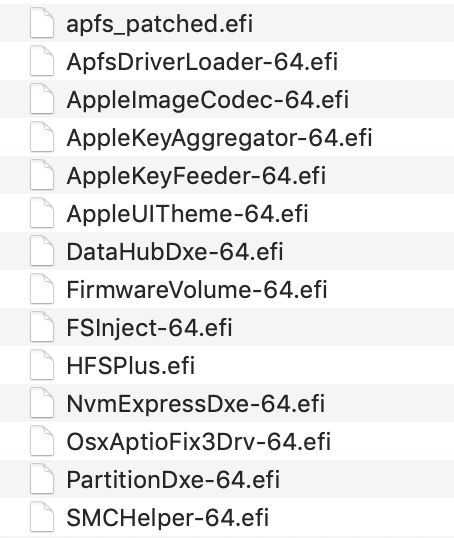
Was someone able to install the latest version of clover (4895)? I'm using 4674 right now an it works absolutely fine. If I update to 4895 or 4901 (which was released nearly an hour ago), I can't boot anymore. I get stuck at the TianoCore logo. I've discovered a new driver AudioDxe-64.efi, which I guessed I won't need anyway and sounds like it could cause problems. After deleting it it shows "clover 4895, scan entries". But nothing more happens. Tried it with HFSPlus.efi and VBoxhfs.efi, neither worked and also not both at the same time... Beside that, I don't use any unusual drivers. Also tried replacing the new drivers64UEFI folder with my backed up one, but won't boot either. The image attached shows all the driver I'm currently using with clover 4674. EDIT: I've also tried removing my old drivers64UEFI folder before the installation, so all drivers will get installed. After that I've copied the Apple* ones over, but also doesn't work. EDIT2: So I found a version which could maybe work (4862 from tonymacx86). My external USB backup drive (HFS+) is recognized. But usually I'm using an NVMe drive with APFS. I'm pretty sure the APFS filesystem isn't working properly... and I've already tried different drivers. EDIT3: Finally got it working (at least 4862 from tonymacx86). The problem was ApfsDriverLoader-64.efi. Had to delete it completely and instead use only apfs-patched.efi. Now its working so far