





JesterEE
Members
-
Joined
-
Last visited
Everything posted by JesterEE
-
My 2 cents, using virtual machines for gaming is effectively dead. If your game of choice currently works, count your lucky stars and don't hold your breath on continued support. This is a real shame but until virtualized configurations become a significantly larger market share and are depended on by "normal" people, I don't expect anything to change. I personally looked into the amount of work it would take to recompile QEMU on Slackware with the hope that maybe there's a low probability chance a masked version could work on Unraid, but I gave up because it just wasn't worth my time after fighting a slew of dependency and build chain issues. I'm sure with the right skills you could get this to work (I got close) but it would only be a matter of time before another anti-cheat engine comes in and breaks any camouflaging you may come up with. There are still a few options that are not VM related that you can look into. If you Google dockerized game streaming solutions you can find a few options in that space that work right now but offer different real world trade-offs. As Linux gaming on shared hardware gets more popular, maybe these anti-cheat development companies will change their practices, but right now it's effectively a "vote with your wallet" scenario. In my opinion, based on how they are currently looking to embrace Linux with compatibility only for a extremely small subset of Linux distributions, the future looks bleak for virtualization support.
-
I haven't had too much time to play in the lab the last couple weeks but I did get some time yesterday to work with StaXX a bit more. Since last I used the interface, I can tell there has been a significant amount of changes, both on the UI and under the hood. All the new notifications seem to work well with the core UI and the info being conveyed feels intuitive for the compose initiated. At this point I feel very comfortable navigating the UI and it feels purposeful and informative. I tend to use a combination of the template and the notepad editor depending on what I'm trying to do, and for small to medium sized compose files it works great. Once my stack starts to get a bit large (4-5 containers), the UI lag gets significant and the synchronization between template and text editor gets "touchy" where a short cursor move on the editor snaps the template interface. It's pretty hard to describe, but it's like a rubber banding effect that makes navigating difficult and further lags the page. Lately my biggest gripe right now are the errors that get generated by breaking the syntax in the compose.yml file. The screen will spam with parsing errors in popup dialogs and it's hard to get control back to the interface. Outside of that, I think everything is coming together and I'm excited to see what you are looking at next. I'll log that but report as well as a few more feature requests that have come up since my last submissions. As for the dashboard widget I like it! At first I didn't like that it didn't bring over my folders from StaXX for me, but then I realized I wanted to change some of the folder structures for my dashboard so that it's actually wound up being a little different than my StaXX UI. Maybe it would be good to default a stack to the folder that it was first assigned to in the StaXX UI but then allow the user to change the dashboard placement independently? Also, when I change the number of columns and rows to a smaller number than the default, the stack tiles got bigger to fit the space, but whenever the dashboard loads, it defaults to a four column grid until the code adjusts the size and snaps the stacks to the users grid specification. I'm nitpicking, but that snap is a little jarring. Could that page load the user selected grid size before loading the default grid to avoid the jumping widget?
-
I would like to request this feature too. Nvidia releases both "new feature" and "production" releases on their github page and it looks like the plugin and accompanying CI chain only tracks production releases.
-
Can't wait to give it a shot! I'm now 100% migrated over to StaXX and enjoying the flexibility it offers. So far, everything has been bulletproof! Thanks for your killer plugin! I also added a few items to your tracker so I don't further contribute to the bloat on this thread for dev items. Thanks for implementing the OAuth!
-
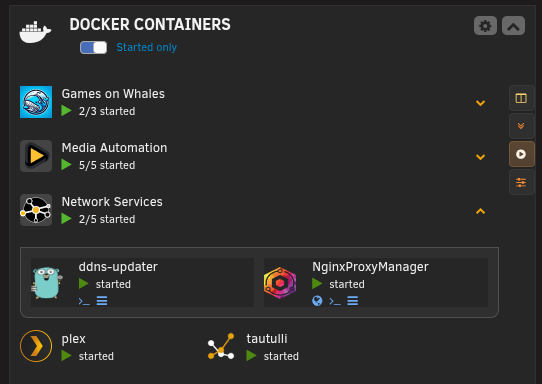
The ask here is a StaXX dashboard widget that replicates/overrides the docker widget's functionality with folder/stack layering. See the included image of a sample of my docker widget with the FolderView3 tweaks enabled on my server's dashboard. Note that there are "folders" for grouped services which are expandable/collapsible, and all the other non-grouped services are listed below it. Show started only vs show all remains intact, and the docker grouping I implemented in the plugin is preserved on the dashboard widget. I can control the running status, launch the WebUI, command prompt, log window, etc. right from the dashboard. Currently, I have FolderView3 working with StaXX to provide this functionality. For example, in the image I shared, the ddns-updater container is deployed in StaXX while Nginx Proxy Manager is deployed as a normal docker. Even though Unraid registers my ddns-updater container as managed by compose, it still lists it in the docker page and thus still applies the folder rules I set in FolderView3 to group it with my other Networking containers. I'd like to abandon all need for FolderView3 with a complete migration to StaXX and this it a hold-out feature for me. It is also why I requested adding custom stack/folder icons in (2). One thing that FolderView3 can do that I really like is using 3rd party icons for folders; specifically hernandito's Animated "Docker-Folder" Icons for unRAID. Is it functional? No. Is it silly? Yes! But, we are simple creatures and it brings me joy to see nice animated images for my deployed services. & 4. I was surprised to see many projects don't offer a source of truth docker compose YAML file indicating the many options available to the container. This was a little surprising for me coming from Unraid templates which, more or less, usually include a means for full configurability of the container from the source template. Now that I know this, StaXX is doing a good job at trying it's best to be smart, but the source maintainers aren't making it easy. This is yet another challenge the Unraid devs face as they embrace compose in the future. For StaXX, I think you're doing the best you can, and I can't think of a better way to do it so please disregard these requests. I hope a better solution emerges in the future, and if that happens, I think you already have the infrastructure in StaXX to embrace it. I know I compared StaXX to FolderView3 a bunch, but I think StaXX gets to the real heart of the matter while FolderView3 just masks the inherent limitations of a non-compose based deployment in the Unraid GUI. I think StaXX is in a position to do it all better, but the lessons learned through the development of the many iterations of FolderView should not go to waste. If you are unfamiliar with FolderView and don't want to install it to see (I get it!), I suggest watching a few of AlienTech42's YouTube videos on the configuration of the plugin so you see what it can do and how StaXX can benefit.
-
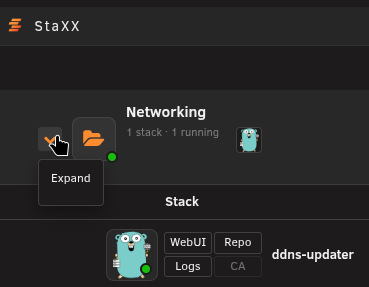
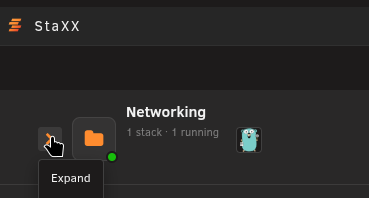
Your welcome! It's really been nice updating my homelab with StaXX. IMHO docker compose is now necessary for deploying most docker services on a homelab. Gone are the days of spinning up a single container to handle a whole workload, and StaXX makes the transition from individual, disparate images to organized stacks bearable. I'm glad I found it when I did! Thanks for hearing out my comments and feedback! I have already been using some of the features you implemented and I'm finding less "gotchas' as I use the tool. Originally I tried to use your dev board to submit my bugs and requests, but it asked me to create a login. Sorry to say, this was a dealbreaker for me using your submission system . I understand why this makes it easier for you as you work with your AI assistant to make the tool better, but for me as a user, it's just one more set of credentials I have to manage for a system I won't use more than a few times. I understand why you'd want/need a login mechanism for this service to keep the garbage out of your tracker, but to encourage user input, might I suggest a different means of verification like OpenID Connect. This might be overkill for your project, but it also may encourage others to contribute. About the Collapse/Expand arrows, I still see it on my end, but I have been experiencing issues with the Docker page on my server updating dynamic events properly (e.g. refreshing after an update). I believe this may be due to the FolderView3 plugin, which is mostly pretty great, but can be somewhat wonky at times. Using the STaXX settings, I moved StaXX it to it's own page to hopefully remove any plugin conflicts with the default docker page, but I still see this issue. Take this as a grain of salt as this very well could be a me issue and I'm ok with that; it's extremely minor and does not affect the way StaXX works. See included screenshots of a simple folder with a single stack. Thanks again for working on this and I will report back if I find anything else as I continue to migrate images and deploy new services.
-
Feedback: It took me a while to notice the 'add file' buttons for the compose configuration. Now that I see it, it's obvious, but it took me forever to find it. Maybe it's just me, but if the '+' button were closer to the compose.yaml tab like it appears on modern web browser UIs, I think I would have found it faster. Dragging and dropping a stack onto a folder will yield an error "Only a ".staxx" bundle can be dropped here." I realize this is not the proper way to add a stack to a folder, but it is intuitive to perform this action since it looks like a file explorer, and it doesn't do what was expected. Bugs: .env files do not display blank lines. Also causes navigation/display corruption in the editor. Staxx does not respect the Unraid lock sortable items UI element. Folder Collapse/Expand arrows always displays "Collapse" regardless of state Unable to return to split view after selecting Form/Compose view Feature Requests (by desire level): Dashboard docker widget integration (Similar to FolderView3) Stack/Folder custom icons (Similar to FolderView3) Notification/Automerge of upstream docker compose environment (YAML, env files, etc.) modifications One of my biggest gripes with the current Unraid docker template system is that when a docker template is updated by the author, there is no way for a current user to easily merge the changes into the template deployed in Unraid. Staxx offers an infrastructure that could do this better while not compromising user modifications to the upstream configs.
-
Staxx came at the perfect time for me this week! I needed to roll out a new docker "stack" on my machine, and I finally decided to try and do it in compose to keep things cleaner. I happened to find Staxx in CA while I was considering the latest compose options, and after seeing the feature set, I decided to take it for a spin. I have not completely migrated all my dockers over, but I have set up a new Staxx stack from a compose file, installed an app from CA into Staxx, and migrated an existing container over to Staxx. All went pretty well! After gaining a little bit of knowledge through experimentation and exploring the Staxx UI, I was able to find the features I was looking for and get a number of containers running and working as expected in my environment. Overall, I am impressed with the abilities of the plugin. Since I'm not a regular compose user, I might not understand what Staxx may be missing that would be beneficial for doing complex compose setups, but for typical, everyday setups, I found it pretty easy to get comfortable with and use. Though, I found a couple bugs, and have a few suggestions which I will list below, I plan to continue to use this plugin for my docker needs in preparation for compose integration in Unraid 8. I hope the @limetech devs take note of this plugins functionality as they work on the next native implementation. This solution checks a lot of boxes!
-
Thanks for your work on this implementation of Krusader. I was looking at potentially migrating to your linuxserver/selkies based image from the ich777/krusader image and was putting them through some paces together. Overall, I think I liked the Selkies based image better due to the smooth feel of working in the browser with less visual artifacts which is nice when doing mundane file tasks. A few feedback notes. Quitting the application in the browser will cause the image to hang (black screen) with no way to recover into a new Krusader session without restarting the container. The functionality in ich777/krusader is (IMO) more desirable where closing the application in the browser window and reconnecting to noVNC (or refreshing the window) will restart the Krusader application. There is no diff tool in the base image. Please consider bundling in kompare or a similar tool to link with Krusader. This image consumes much more RAM than the noVNC based krusader container (~600 MB - 1.2 GB more by my testing). I'm fairly sure this is due to the heavier backend and video rendering requirement so I'm not sure what can be done about this, but for me, a 1 GB+ RAM requirement to run a file manager is a bit too heavy. If this could be halved through image optimization I would likely switch over. I thought the increased RAM usage might be due to the default CPU video rendering, so I modified the image to to use my NVIDIA 3070 GPU based on the Selkies GPU docs but RAM usage remained high (~800-900 MB idle). The GPU rendering pipeline did help a lot when resizing the window (no wait for the window alignment and font scaling to render vs a few seconds on the CPU rendering) but docker RAM usage was mostly unaffected. To render the web browser window at 3440 x 1274 @ 60FPS the hardware encoder required ~950 MB of VRAM.
-
Tried this today on my Bazzite Linux VM with Back 4 Blood and the solution is not working. Looks like in the future before I buy a game, I'm going to have to cross reference these lists to see if it's going to give me issues: https://steamdb.info/tech/AntiCheat/EasyAntiCheat/ https://steamdb.info/tech/AntiCheat/BattlEye/
-
@SpaceInvaderOne I finally got around to giving this plugin a try today and I am having the same problem as the users above. As reported by the plugin, I have 8 LUKS devices: 6 on my main array (4 with LUKS V1 and 2 with LUKS V2) and 2 on my cache pool (both LUKS V2). The plugin would not assign the hardware-derived key on slot 31 to any of my array drives, but it did assign the hardware-derived key on slot 31 to my cache pool drives. I'm not sure if the LUKS version matters, but I don't understand how my array drives got a mix of V1 and V2. All drives were encrypted by various releases of Unraid V6. Judging by which of my drives have which LUKS version, it looks like somewhere in the mid-late Unraid V6 releases (maybe 6.9 or 6.10) the default was changed to V2, and then reverted back to V1 in later releases. Though, this is speculation and I have nothing more than this anecdotal evidence. Also, an additional bug to report, when I removed the Auto-Unlock functionality (since it wasn't going to work for me in this state anyway), it did not remove the Slot 31 hardware-derived key from the cache pool drives! I have a before and after LUKS analysis from your plugin I will share with you, with server diagnostics, via PM. IMHO, this plugin is great and I really hope I get to use it. Happy to help you debug this issue, as long as my data is sufficiently safe as we do it! Thanks JesterEE
-
Sounds like the driver is fighting for control of the fans on the backend and getting stuck in an odd state. Have you disabled motherboard control of all fans except your CPU? Do you have any other plugins or containers installed that poll the fans?
-
Oddly enough, I just saw this on my Community Apps feed today. Looks like there's a timely solution for us though I have not tried it yet.
-
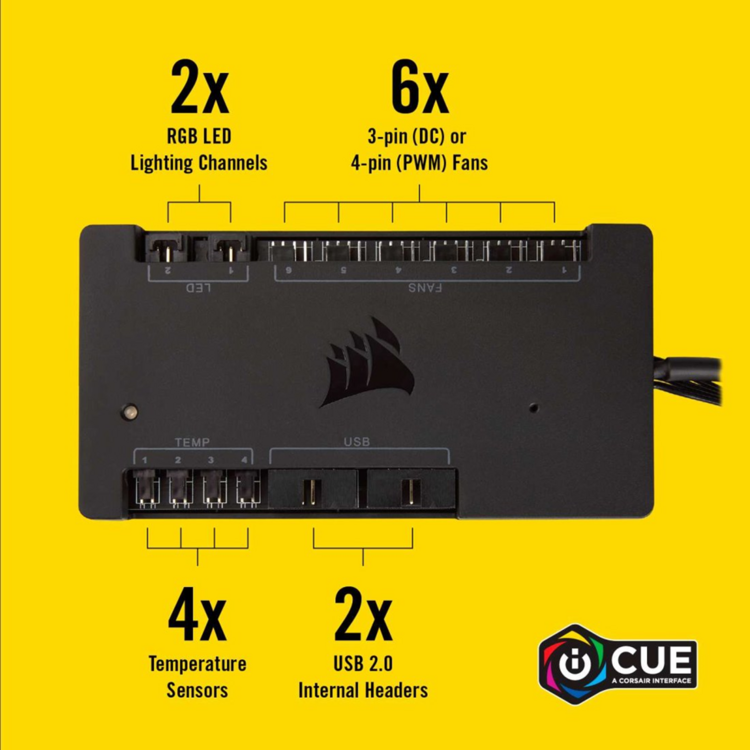
I use the Corsair iCUE Commander Pro for my fan controller. This controller (shown in the image attached) has connectors for 4 temperature sensors that you can route throughout your case. On Linux, the individual temperature readings are easily read by the sensors command with the fan speeds as shown in my previous post. Currently, FanCrtl Plus doesn't read these temperatures to adjust fan curves, but I'm holding out hope @CkChong sees the value in reading external temperature sensors and adds that functionality in a future release.
-
How did this topic go from asking about a removed feature and potentially asking for it to be reintroduced by the Limetech Dev team from a previous build to using AI to vibe code a solution to recreate the wheel?? Respectfully, I know you're trying to help but without the Dev team contributing to the conversation, outside of creating a plug-in to sideload the feature, I'm not sure there's a conversation to be had. Join works well, and I never had an issue with it, but I'll probably move on to an Unraid supported mechanism if it has been dropped. As for flexing, some Dev muscles to create a plug-in for the community, more power to you. I'm not sure there's a need for this one as only two of us users have commented on this and it's probably been removed for a while, so the reach will be fairly minimal. Join as an Android application and service seems to be in maintenance mode, and that is being generous. There's no reason for active development by the Join Dev since it has worked the same since Android v10, but the last Android app update was in June 2024. @limetech @ljm42 @SpencerJ Thoughts on the OP? Was this agent removed for a reason? Just looking for some clarification since I didn't see anything in any change logs.
-
This is a known issue with the way the plugin functions. You can not update a container which creates a network for other containers with this plugin because you can not ensure the dependent containers will be restarted after the update. This is required by docker networking since the network references become stale, still being linked to the previous container ID for actively running dependant containers. From what I understood when I looked into this myself over a year ago, it has to do with the Docker Unraid UI page itself which maintains the functionality to trigger the restart of the dependent containers rather than a universal backend mechanism. This is why it works on the Unraid UI when manually updating and not with the plugin. I personally deactivated the auto update for my VPN container and either update it manually or use the Backup/Restore Appdata plugin to trigger a dependent update once a week during the automated backup task maintenance. If you do the later method, you can create a start order of your VPN and dependant containers so they start in the correct order after a backup and update.
-
Hello Unraiders, I recently had my server offline for a while (~5 months) due to some technical issues and updated from 7.0 -> 7.1.4 when I was able to get it back online. Since it was so long since I had the server on, I was giving it a bit of a configuration cleaning; going through all the options to make sure things are set up correctly after the gap in updates. When I went in the Notifications Settings (Settings -> User Preferences -> Notification Settings), I noticed that the Join agent I am using was no longer listed as an option. Since I had this agent configured before it was removed somewhere along the line, I am still getting notifications via this agent with my previous settings intact and valid (/boot/config/plugins/dynamix/notifications/agents/Join.sh). I did a search on the Unraid forum and Unraid OS change logs to see when this feature was depreciated, but I could not find anything referencing Join. Does anyone have any ideas on why this agent was removed? Was there something malicious I should be worried about? I am open to switching notification services, but other than running my own Gotify server to ensure true security by not having another service in the middle, none of the options seem any more appealing than Join.
-
I came across your plugin today and immediately downloaded it! I have been hoping to incorporate this functionality native in Unraid for a while and I'm really happy you developed this application and it's continued development. Up till now I have been using liquidctl with the LaaC docker to control my fans with a Corsair Commander Pro, but this lets me also track drive temps for cooling. This is great especially when running array intensive tasks like array parity checks which gives me much more piece of mind. One thing I miss is the ability to also use the temperature sensors I have scattered around my case to add additional temperature dependency for my fan curves. Specifically, my temperature sensors from my ASUS motherboard and my Corsair Commander Pro. I have included the output from the sensors command on my system to illustrate the outputs I'm getting on these drivers, and also to highlight how the ASUS reporting driver differs from the k10 temp driver I'm currently using to supply FanCrtl Plus with data. Thanks again and I will continue to track this project! root@SERVER:~# sensors ... corsaircpro-hid-3-2 Adapter: HID adapter in0: 12.03 V in1: 5.05 V in2: 3.45 V fan1 4pin: 1240 RPM fan2 4pin: 1302 RPM fan3 4pin: 1110 RPM fan4 4pin: 939 RPM fan5 4pin: 1253 RPM fan6 4pin: 1316 RPM temp1: +28.4°C temp2: +21.2°C temp3: +22.5°C temp4: +24.8°C k10temp-pci-00c3 Adapter: PCI adapter CPU Temp: +61.1°C MB Temp: +54.0°C Tccd2: +31.5°C asusec-isa-0000 Adapter: ISA adapter CPU Core: 1.44 V Chipset: 3199 RPM Chipset: +64.0°C CPU: +51.0°C Motherboard: +30.0°C T_Sensor: +35.0°C CPU: 36.00 A nvme-pci-0100 Adapter: PCI adapter Composite: +40.9°C (low = -273.1°C, high = +81.8°C) (crit = +84.8°C) Sensor 1: +40.9°C (low = -273.1°C, high = +65261.8°C) Sensor 2: +44.9°C (low = -273.1°C, high = +65261.8°C)
-
Quick little pro-tip for forum posterity. I force updated the LaaC image today because I was doing some system maintenance (don't ask, I didn't need to do it, but I did), and afterward I was getting this error in the LaaC docker log on container start: ERROR: no device matches available drivers and selection criteria Thinking I messed the image up, I deleted my template and reinstalled from Community Apps, though I was met with the same error. The device was still recognized on the host in the /sys/bus/usb/devices/X-Y and /dev/bus/usb/XXX/YYY locations (I use the former in my template) so it wasn't an availability issue. On a lark, I thought that the device might not have been let go correctly by docker when I force updated the image and the device is now bound to an invalid endpoint (or something like that). So I stopped the running LaaC container, and ran these commands in a su terminal: echo 'X-Y' | tee /sys/bus/usb/drivers/usb/unbind echo 'X-Y' | tee /sys/bus/usb/drivers/usb/bind Upon restarting the LaaC container, my Corsair Commander was once again able to be seen by liquidctl. Hope this helps someone in the future!
-
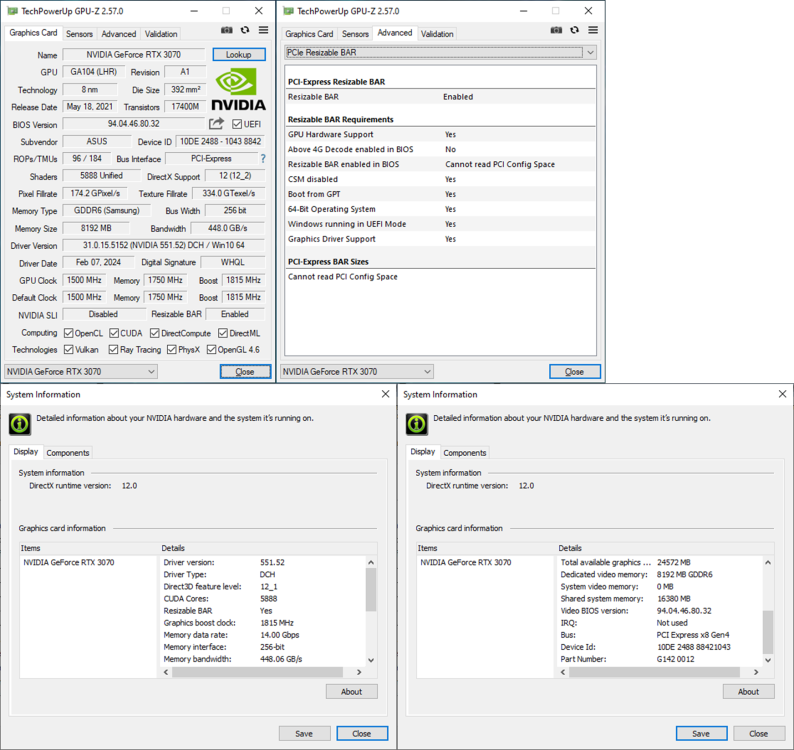
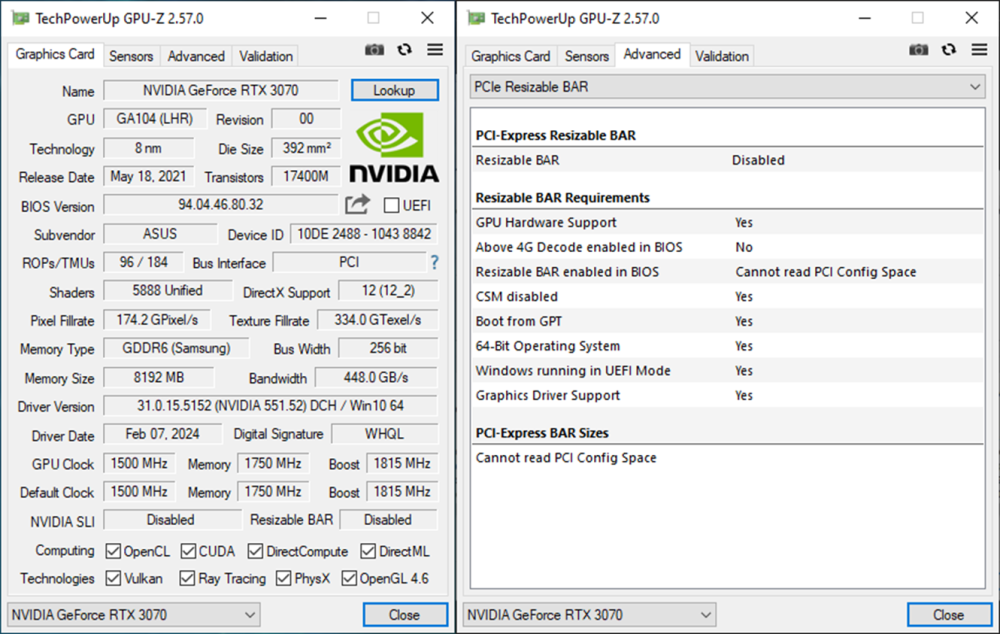
With the Unraid 6.12 series on Linux kernel 6.1 natively, I decided to finally revisit this topic with my update to 6.12.8. After the OS update, I checked the lspci output to see if the OS was correctly assigning the correct memory size allocation for my ASUS KO GeForce RTX 3070 V2 OC Edition 8GB. I was pleasantly surprised that without doing anything, it was assigning the resource space to the maximum video memory allotment my card is able to provide (i.e. 8GB) (see full lspci output at bottom of this post). # lspci -vvvs 0c:00.0 0c:00.0 VGA compatible controller: NVIDIA Corporation GA104 [GeForce RTX 3070 Lite Hash Rate] (rev a1) (prog-if 00 [VGA controller]) Subsystem: ASUSTeK Computer Inc. GA104 [GeForce RTX 3070 Lite Hash Rate] Capabilities: [bb0 v1] Physical Resizable BAR BAR 0: current size: 16MB, supported: 16MB BAR 1: current size: 8GB, supported: 64MB 128MB 256MB 512MB 1GB 2GB 4GB 8GB BAR 3: current size: 32MB, supported: 32MB Note the BAR 1 size is set to 8GB. Before the kernel update (and with the kernel patch referenced in the earlier pages of this thread), it was set to a default of 256MB. All is looking good so far! I followed the these baseline steps ✅ Host BIOS UEFI w/o CSM ✅ Host BIOS Enable ReBAR support ✅ Host BIOS Enable 4G Decoding ⬛ Enable & Boot Custom Kernel syslinux configuration (near beginning of this thread) not needed anymore Before modifying my Windows 10 Pro VM configuration, I booted up the VM to see if anything was needed for the Guest OS to recognize ReBAR. I did make sure my guest bios was set to OVMF TPM (regular OVMF provided the same result as shown below though). Windows booted without issue and I ran both GPU-Z 2.57.0 and the NVIDIA Control Panel to check ReBAR support: This is what I saw: GPU-Z reported ReBAR as Enabled, but when I went into the Advanced settings, 4G Decode was shown as Disabled in BIOS. NVIDIA Control Panel shows ReBAR an Enabled and shows it's correctly allocating 8GB of dedicated video memory with an additional 16GB of shared memory for 24GB total. If I close the apps and relaunch them, GPU-Z reports differently, showing ReBAR as Disabled with the same advanced details (NVIDIA Control Panel stays reporting ReBAR Enabled with the same details). I shut down the VM and tried the XML edits noted in this thread and other online spaces talking about VFIO ReBAR: <domain type='kvm'> ➡️ <domain type='kvm' xmlns:qemu='http://libvirt.org/schemas/domain/qemu/1.0'> <qemu:commandline> <qemu:arg value='-fw_cfg'/> <qemu:arg value='opt/ovmf/X-PciMmio64Mb,string=65536'/> </qemu:commandline> After relaunching the VM, I found the results to be the same. So, this is interesting in that the XML may not be required for ReBAR anymore either. However, since I'm getting inconsistent reporting using GPU-Z and the NVIDIA Control Panel, I can't be sure. I think I trust NVIDIA Control Panel more than GPU-Z on this one even though GPU-Z has never steered me wrong in the past. I figure the hardware vendors driver information software probably knows better and GPU-Z is looking at some inconsistent information and reporting incorrectly. But, I think putting a synthetic benchmark to test Host BIOS setting differences is probably called for in this scenario (ReBar and 4G Decoding On vs Off). I'll report some of that in a follow-up post. Anyone else see something similar to what I'm seeing and have verified ReBAR functional in their VM? -JesterEE # lspci -vvvs 0c:00.0 0c:00.0 VGA compatible controller: NVIDIA Corporation GA104 [GeForce RTX 3070 Lite Hash Rate] (rev a1) (prog-if 00 [VGA controller]) Subsystem: ASUSTeK Computer Inc. GA104 [GeForce RTX 3070 Lite Hash Rate] Control: I/O+ Mem+ BusMaster+ SpecCycle- MemWINV- VGASnoop- ParErr- Stepping- SERR- FastB2B- DisINTx+ Status: Cap+ 66MHz- UDF- FastB2B- ParErr- DEVSEL=fast >TAbort- <TAbort- <MAbort- >SERR- <PERR- INTx- Latency: 0, Cache Line Size: 64 bytes Interrupt: pin A routed to IRQ 141 IOMMU group: 30 Region 0: Memory at fb000000 (32-bit, non-prefetchable) [size=16M] Region 1: Memory at 7c00000000 (64-bit, prefetchable) [size=8G] Region 3: Memory at 7e00000000 (64-bit, prefetchable) [size=32M] Region 5: I/O ports at f000 [size=128] Expansion ROM at fc000000 [disabled] [size=512K] Capabilities: [60] Power Management version 3 Flags: PMEClk- DSI- D1- D2- AuxCurrent=0mA PME(D0+,D1-,D2-,D3hot+,D3cold-) Status: D0 NoSoftRst+ PME-Enable- DSel=0 DScale=0 PME- Capabilities: [68] MSI: Enable+ Count=1/1 Maskable- 64bit+ Address: 00000000fee00000 Data: 0000 Capabilities: [78] Express (v2) Legacy Endpoint, MSI 00 DevCap: MaxPayload 256 bytes, PhantFunc 0, Latency L0s unlimited, L1 <64us ExtTag+ AttnBtn- AttnInd- PwrInd- RBE+ FLReset+ DevCtl: CorrErr+ NonFatalErr+ FatalErr+ UnsupReq+ RlxdOrd+ ExtTag+ PhantFunc- AuxPwr- NoSnoop- FLReset- MaxPayload 256 bytes, MaxReadReq 512 bytes DevSta: CorrErr- NonFatalErr- FatalErr- UnsupReq- AuxPwr- TransPend- LnkCap: Port #0, Speed 16GT/s, Width x16, ASPM L0s L1, Exit Latency L0s <512ns, L1 <16us ClockPM+ Surprise- LLActRep- BwNot- ASPMOptComp+ LnkCtl: ASPM Disabled; RCB 64 bytes, Disabled- CommClk+ ExtSynch- ClockPM- AutWidDis- BWInt- AutBWInt- LnkSta: Speed 2.5GT/s (downgraded), Width x8 (downgraded) TrErr- Train- SlotClk+ DLActive- BWMgmt- ABWMgmt- DevCap2: Completion Timeout: Range AB, TimeoutDis+ NROPrPrP- LTR- 10BitTagComp+ 10BitTagReq+ OBFF Via message, ExtFmt- EETLPPrefix- EmergencyPowerReduction Not Supported, EmergencyPowerReductionInit- FRS- AtomicOpsCap: 32bit- 64bit- 128bitCAS- DevCtl2: Completion Timeout: 50us to 50ms, TimeoutDis- LTR- 10BitTagReq- OBFF Disabled, AtomicOpsCtl: ReqEn- LnkCap2: Supported Link Speeds: 2.5-16GT/s, Crosslink- Retimer+ 2Retimers+ DRS- LnkCtl2: Target Link Speed: 16GT/s, EnterCompliance- SpeedDis- Transmit Margin: Normal Operating Range, EnterModifiedCompliance- ComplianceSOS- Compliance Preset/De-emphasis: -6dB de-emphasis, 0dB preshoot LnkSta2: Current De-emphasis Level: -3.5dB, EqualizationComplete+ EqualizationPhase1+ EqualizationPhase2+ EqualizationPhase3+ LinkEqualizationRequest- Retimer- 2Retimers- CrosslinkRes: unsupported Capabilities: [b4] Vendor Specific Information: Len=14 <?> Capabilities: [100 v1] Virtual Channel Caps: LPEVC=0 RefClk=100ns PATEntryBits=1 Arb: Fixed- WRR32- WRR64- WRR128- Ctrl: ArbSelect=Fixed Status: InProgress- VC0: Caps: PATOffset=00 MaxTimeSlots=1 RejSnoopTrans- Arb: Fixed- WRR32- WRR64- WRR128- TWRR128- WRR256- Ctrl: Enable+ ID=0 ArbSelect=Fixed TC/VC=01 Status: NegoPending- InProgress- Capabilities: [258 v1] L1 PM Substates L1SubCap: PCI-PM_L1.2+ PCI-PM_L1.1+ ASPM_L1.2+ ASPM_L1.1+ L1_PM_Substates+ PortCommonModeRestoreTime=255us PortTPowerOnTime=10us L1SubCtl1: PCI-PM_L1.2- PCI-PM_L1.1- ASPM_L1.2- ASPM_L1.1- T_CommonMode=0us LTR1.2_Threshold=0ns L1SubCtl2: T_PwrOn=10us Capabilities: [128 v1] Power Budgeting <?> Capabilities: [420 v2] Advanced Error Reporting UESta: DLP- SDES- TLP- FCP- CmpltTO- CmpltAbrt- UnxCmplt- RxOF- MalfTLP- ECRC- UnsupReq- ACSViol- UEMsk: DLP- SDES- TLP- FCP- CmpltTO- CmpltAbrt- UnxCmplt- RxOF- MalfTLP- ECRC- UnsupReq- ACSViol- UESvrt: DLP+ SDES+ TLP- FCP+ CmpltTO- CmpltAbrt- UnxCmplt- RxOF+ MalfTLP+ ECRC- UnsupReq- ACSViol- CESta: RxErr- BadTLP- BadDLLP- Rollover- Timeout- AdvNonFatalErr- CEMsk: RxErr- BadTLP- BadDLLP- Rollover- Timeout- AdvNonFatalErr+ AERCap: First Error Pointer: 00, ECRCGenCap- ECRCGenEn- ECRCChkCap- ECRCChkEn- MultHdrRecCap- MultHdrRecEn- TLPPfxPres- HdrLogCap- HeaderLog: 00000000 00000000 00000000 00000000 Capabilities: [600 v1] Vendor Specific Information: ID=0001 Rev=1 Len=024 <?> Capabilities: [900 v1] Secondary PCI Express LnkCtl3: LnkEquIntrruptEn- PerformEqu- LaneErrStat: 0 Capabilities: [bb0 v1] Physical Resizable BAR BAR 0: current size: 16MB, supported: 16MB BAR 1: current size: 8GB, supported: 64MB 128MB 256MB 512MB 1GB 2GB 4GB 8GB BAR 3: current size: 32MB, supported: 32MB Capabilities: [c1c v1] Physical Layer 16.0 GT/s <?> Capabilities: [d00 v1] Lane Margining at the Receiver <?> Capabilities: [e00 v1] Data Link Feature <?> Kernel driver in use: vfio-pci Kernel modules: nvidia_drm, nvidia
-
Has this plugin been delisted from CA? Fix Common Problems is showing this after upgrade to 6.12.8 from 6.11.

-
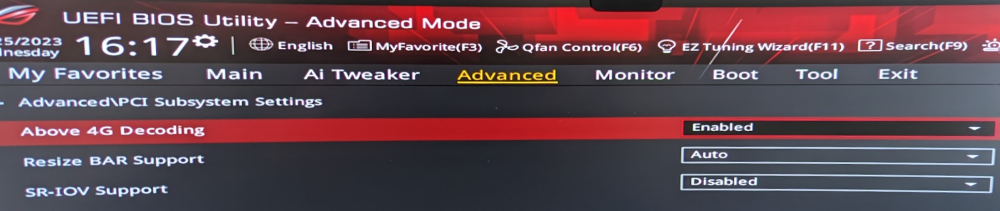
Yes. Above 4G Decoding: Enabled Resize BAR Support: Auto (other option is Disabled)
-
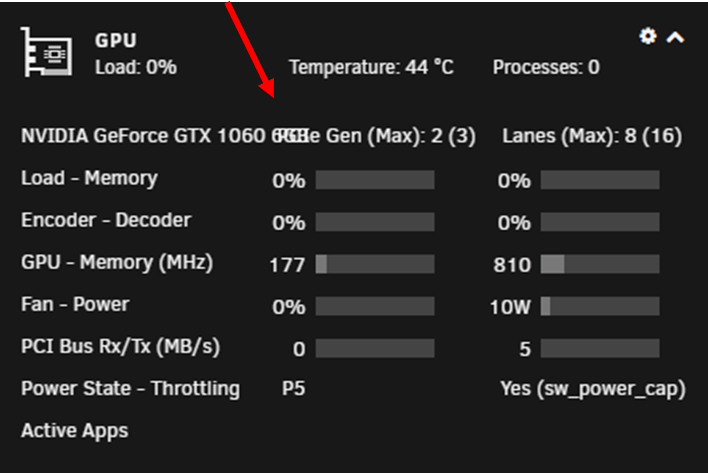
Started using a new video card in Unraid this week and noticed the card name and PCIe Gen columns on the first line are overlapping for may card with a long name. Can the card name be truncated depending on the width of the window (and subsequently the column)?
-
Yup, messed that up in the copypasta while experimenting. Anyway, not a big deal...it works for me if I want to set the ReBAR to acceptable values lower than the default 256MB (for my card [64MB, 128MB, 256MB]) ... But it will not set them higher (for my card [512MB, 1GB, 2GB, 4GB, 8GB]). If I try and set it to a value lower than 64MB or higher than 256MB I will get the error. # -bash: echo: write error: Device or resource busy Here is the is the memory allocation info for my card # lspci -vvvs 0b:00.0 0b:00.0 VGA compatible controller: NVIDIA Corporation GA104 [GeForce RTX 3070 Lite Hash Rate] (rev a1) (prog-if 00 [VGA controller]) ... Region 0: Memory at fb000000 (32-bit, non-prefetchable) [size=16M] Region 1: Memory at d0000000 (64-bit, prefetchable) [size=256M] Region 3: Memory at c8000000 (64-bit, prefetchable) [size=32M] ... Physical Resizable BAR BAR 0: current size: 16MB, supported: 16MB BAR 1: current size: 256MB, supported: 64MB 128MB 256MB 512MB 1GB 2GB 4GB 8GB BAR 3: current size: 32MB, supported: 32MB Thanks for publishing the patch and modified kernel even though it didn't work for me completely. Hope others give it a shot too to report their mileage.
-
No, I changed the addressed on my side, but I posted the command so it could easily be referenced from your post. Here is my version: #!/bin/bash echo -n "0000:0b:00.0" > /sys/bus/pci/drivers/vfio-pci/unbind echo 14 > /sys/bus/pci/devices/0000\:0b\:00.0/resource1_resize # <<<< Gets stuck here echo -n "10de 2488" > /sys/bus/pci/drivers/vfio-pci/new_id || echo -n "0000:0b:00.0" > /sys/bus/pci/drivers/vfio-pci/bind