






Everything posted by UnraidSecretaryOffice
-
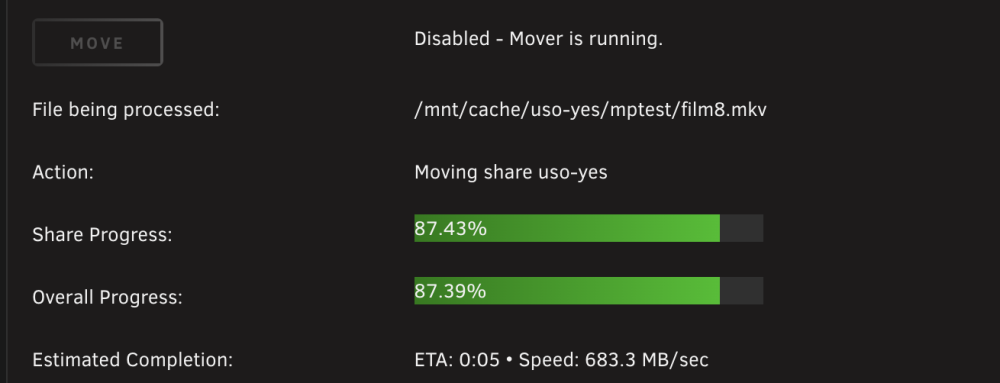
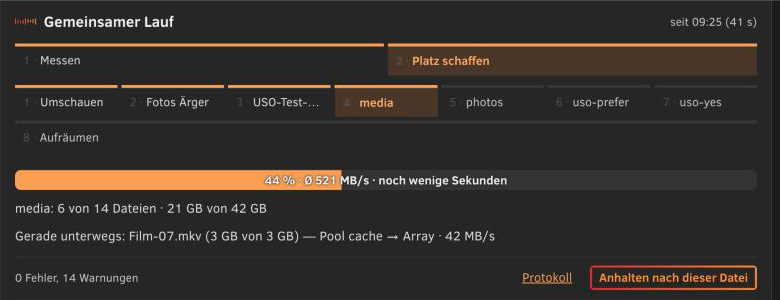
Die Anzeige steht auf Main ganz unten bei "Array Operation", direkt unter dem Move-Button. Zwei Dinge sind mir dabei aufgefallen: - Der Mover liest "Mover Progress" nur beim Start (Mover Settings). Schaltet man es ein, während er schon läuft, kommt für diesen Lauf nichts. Main muss man nach dem Einschalten auch einmal neu laden. - Gezählt wird in ganzen Dateien. Bis die erste Datei fertig ist, steht 0 % und "ETA: Unknown", danach springt der Balken pro Datei. War die Option bei dir schon an, bevor der Mover gestartet ist? Und hast du ein Mover-Plugin installiert, z. B. Mover Tuning? Falls du mehr als das willst, müsstest du auf ein Plugin zurückgreifen oder warten, bis Unraid mehr bietet. Mein USO Plugin bietet den Smart Mover, was ein bisschen mehr anzeigt:
-
Wie sieht es bei dir aus oder was würdest du erwarten?
-
I went through your diagnostics and your screenshot. "docker ps -a" shows 13 containers and no Home Assistant, not even a stopped one, so the container itself was removed. The two paths you tried (/opt/homeassistant, /usr/share/hassio) don't exist on Unraid; with your Docker settings the data would be in a folder under /mnt/user/appdata/. The diagnostics don't list that folder, so they can't show whether the data is still there. A few things they do show: - Appdata Backup has run every night at 00:00 and was killed before it finished on Nov 12, 13 and 14 ("exit status 137", each time a few seconds after the last container was started again). That is probably the error you keep getting. The syslog doesn't show what killed it; the plugin's own log should: Settings → Backup/Restore Appdata → Status / Log. - Home Assistant was not among the containers Unraid auto-started on Nov 11 either. So unless it had autostart off, it may already have been gone three days ago. - Your notification mails fail every night: Gmail rejects the login, it wants an app password. The possible good news: each nightly run writes a folder ab_<date>_<time> to your backup destination, with one archive per container and a copy of the container templates. If Home Assistant was selected, its appdata may still be in one of the older folders and can be put back from the plugin's Restore tab. Before changing anything else, could you post: 1. What exactly happens when you reinstall it (from Apps → Previous Apps?): is there an error, or does it install and come up empty? 2. The output of this command: ls -la /mnt/user/appdata/3. A listing of your Appdata Backup destination folder. 4. The content of the clean-up scripts you ran. The log shows delete_dangling_images, Check Docker Image, delete.ds_store and viewDockerLogSize on Nov 12 and 14. Please don't run any more clean-up scripts until we know where the data is.
-
Do you really mean “not” solved, or is it “now” solved? Since you've already swapped the cable and the switch port, the Intel port is what I'd try next as well. One detail from your diagnostics fits that: the Realtek port dropped many times, but from the moment it fell back to 100 Mbps it didn't drop once. My guess is a contact problem in that port. Just moving the cable won't work: Unraid only has eth0 set up, and eth0 is the Realtek port. Try: 1. Settings → Network Settings → Interface Rules: set "Interface eth0" to the entry that shows (igb) next to it (MAC ending in :18, the Intel port) and "Interface eth1" to the other one (r8169, ending in :17). Apply. 2. Shut the server down. 3. Move the cable to the other network port while it is off, then power on. The server will probably get a new IP address from your router, because the Intel port has a different MAC address. The address is shown on the server's monitor above the login prompt. I couldn't test it on 7.3.4 or with Docker running, so if JorgeB suggests a different way, follow his.
-
2x Kingston KVR64A52BD8-64 (128 GB total) 6400 MHz, DDR5, CU-DIMM with Clock Driver. I bought it back when it first came out for 180.- each. Today, it's priceless—if it's even still available.
-
Der i5-10500 ist für deine Liste eine gute Wahl, vor allem wegen der UHD 630: Die kann per QuickSync H.264 und HEVC (auch 10 Bit) in Hardware umwandeln, damit kommen Jellyfin oder Plex auch mit mehreren Streams zurecht, ohne die CPU zu belasten, was auch Strom spart. Einziger Haken: AV1 kann sie nicht, solche Dateien müsste die CPU umwandeln. Für Immich ebenfalls, da es dieselbe iGPU nutzen kann. Zwei Dinge würde ich vor dem Kauf beim konkreten Modell prüfen, weil sie bei Office-PCs oft knapp sind: Wie viele 3,5"-Plätze das Gehäuse hat. Bei den kleinen SFF-Varianten sind es oft nur zwei oder weniger und wenn später grosse Platten dazukommen sollen, ist ein Tower besser als ein SFF. Ob das Netzteil ein Standard-ATX ist oder ein herstellereigenes. Eigene Netzteile haben kaum freie SATA-Stromstecker.
-
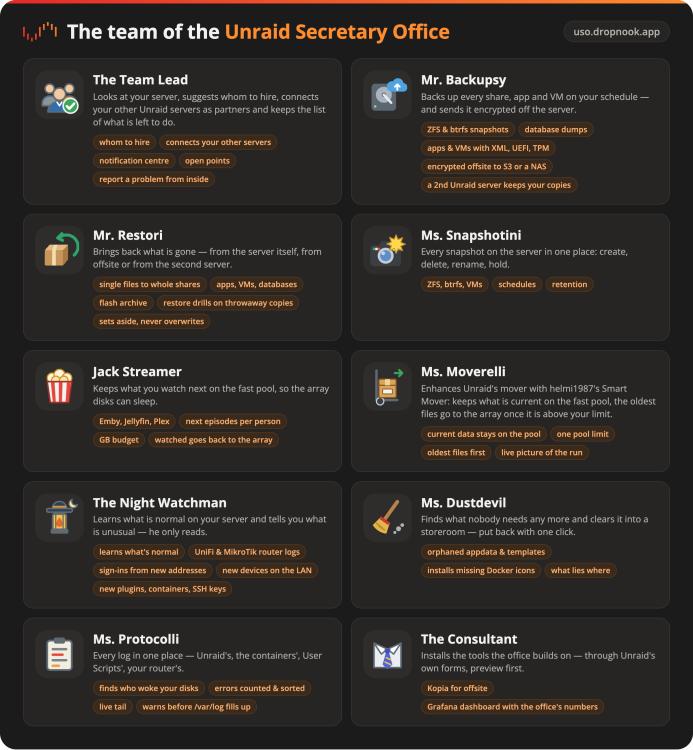
Hi everyone, The Unraid Secretary Office (USO) brings a whole team into Unraid's web UI. Each member of staff looks after one part of your Unraid server. Pictures: https://uso.dropnook.app Install Search for “secretary” in the CA Store and install the “Unraid Secretary Office” plugin by Dropnook. Then open Office in the menu bar (Sekretariat on a German Unraid — you can rename it). Support Questions, problems and wishes: right here in this thread, as a GitHub issue, or straight from the office without a GitHub account (⋯ → Report a problem or a wish…). Thanks The tools behind Jack Streamer and Ms. Moverelli — MediaCache, folder consolidation and Smart Mover — are by helmi1987, and Ms. Protocolli's syslog rules come from Enhanced Log by dlandon and EDACerton. Thank you!
-
Gerne und ich hoffe, dass es jetzt auch stabil bleibt. Du könntest eine Antwort als Lösung markieren. Dann sehen andere in der Forum-Übersicht, dass es hier keine Hilfe mehr braucht. Und falls jemand mal dasselbe Problem hat, kommt er zügig zum richtigen Bereich.
-
Als gute und einigermassen preiswerte Hardware würde ich dir eine Google-TV Box empfehlen. Diese bekommt man i.d.R. wesentlich günstiger als Apple-TV Boxen, brauchen aber u.U. auch mehr Zeit zum Einrichten und Härten wenn man das will (Werbung etc...). Zum Beispiel eine Xiaomi Mi TV Box S (3rd Gen). Als Client-App Moonfin und ggf. zusammen mit dem Moonbase Plugin am Jellifin-Server.
-
Die 30.000 und 60.000 sind nur die Länge des Fehlerprotokolls und alle Einträge sind vom selben Typ, “Invalid Field in Command”, also abgelehnte Verwaltungsbefehle (Abfragen nach etwas, das die Firmware nicht kennt), keine Lese- oder Schreibfehler. Kann man ignorieren. Dein Scrub heute Vormittag ohne Fehler auf beiden Geräten, und seit dem 17. Oktober kein einziger relevanter Fehler im Log. Sieht also gut aus würde ich behaupten. Zwei Dinge am Rande: die beiden nvme1 und nvme0 melden viele Power Cycles und viele Unsafe Shutdowns bei relativ wenig Betriebsstunden. Unraid startet man nicht so häufig, das stammt wohl aus einem früheren Leben der SSDs (gebraucht gekauft, oder vorher in einem Notebook?). Und falls die Aussetzer vom Anfang wiederkommen: Beide NVMes laufen bei dir mit ASPM L1 (PCIe-Stromsparen). Das wäre dann mein erster Verdächtiger, testweise pcie_aspm=off in der Syslinux-Konfiguration. Solange das nicht wieder passiert kannst es aber so lassen. Und Settings → Syslog Server → "Mirror syslog to boot drive" kannst du wieder auf No stellen. Und das Problem scheint vorerst gelöst denke ich.
-
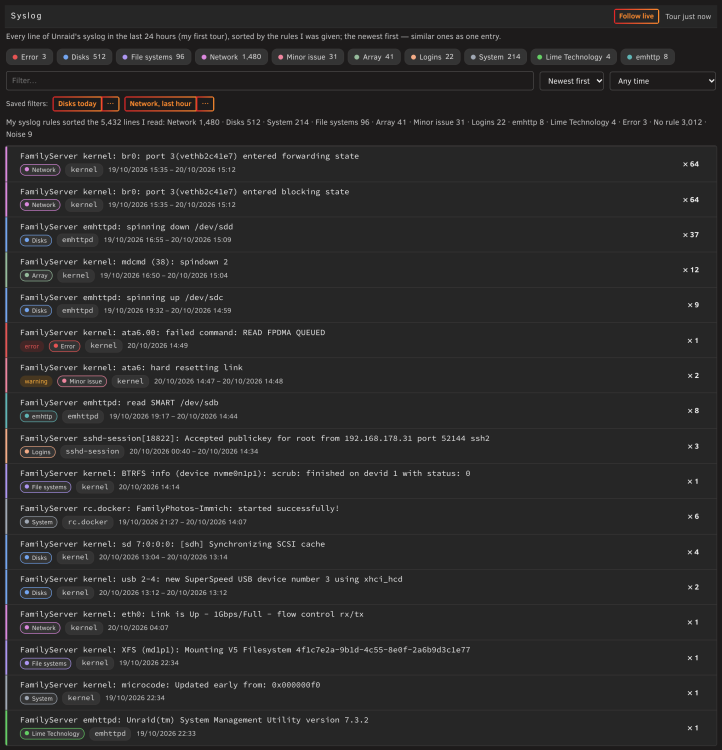
As promised, a short report back: the rule set is in. Ms. Protocolli sorts Unraid’s syslog with Enhanced Log’s rules, shipped unchanged, with Dan Landon’s copyright and the GPL notice kept in the file and the credit to both of you in the README. Her Syslog tile shows the counts per kind (disks, network, file systems, logins, system, errors …), a label shows one kind alone, and you can add your own rules and hide words on top. Thanks again for the years of work in that file. As of today the Unraid Secretary Office isn’t in Community Applications yet (the listing is in review). Until then it installs like any plugin: Plugins → Install Plugin, paste https://github.com/dropnook/UnraidSecretaryOffice/releases/latest/download/unraid-secretary-office.plg — updates then come through Unraid’s plugin manager as usual.
-
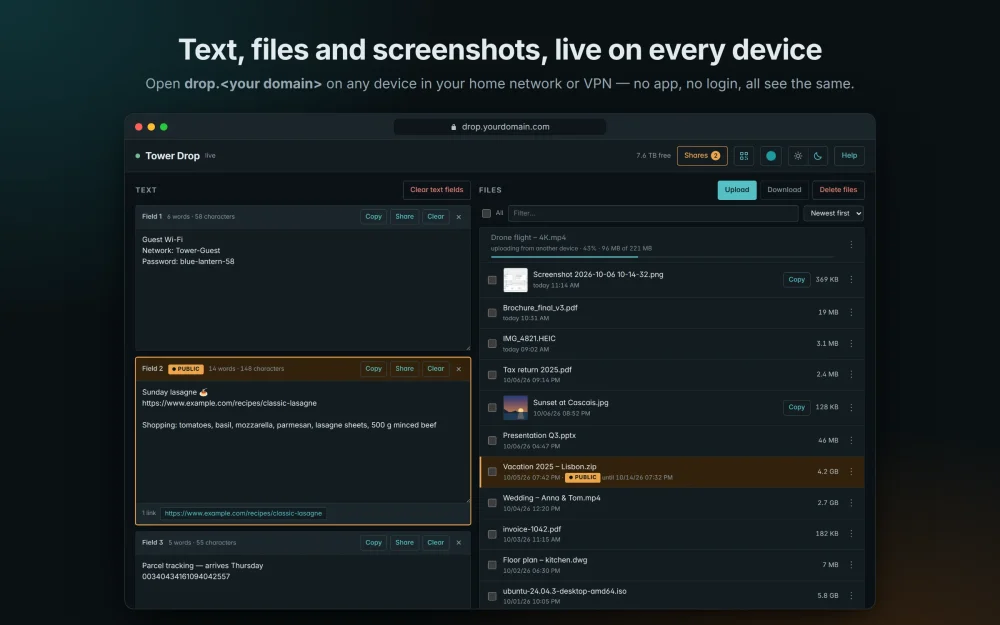
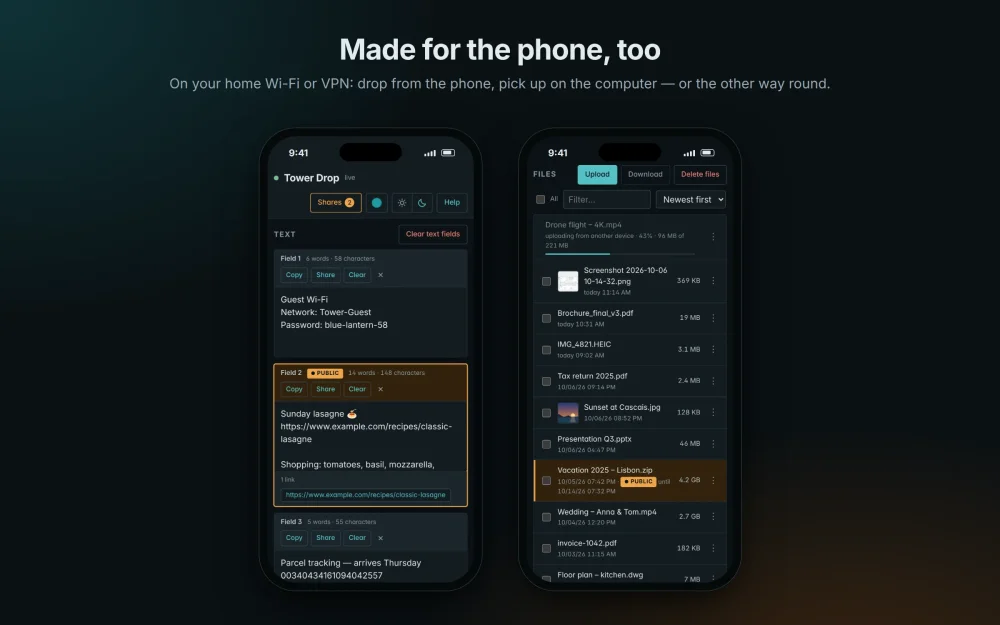
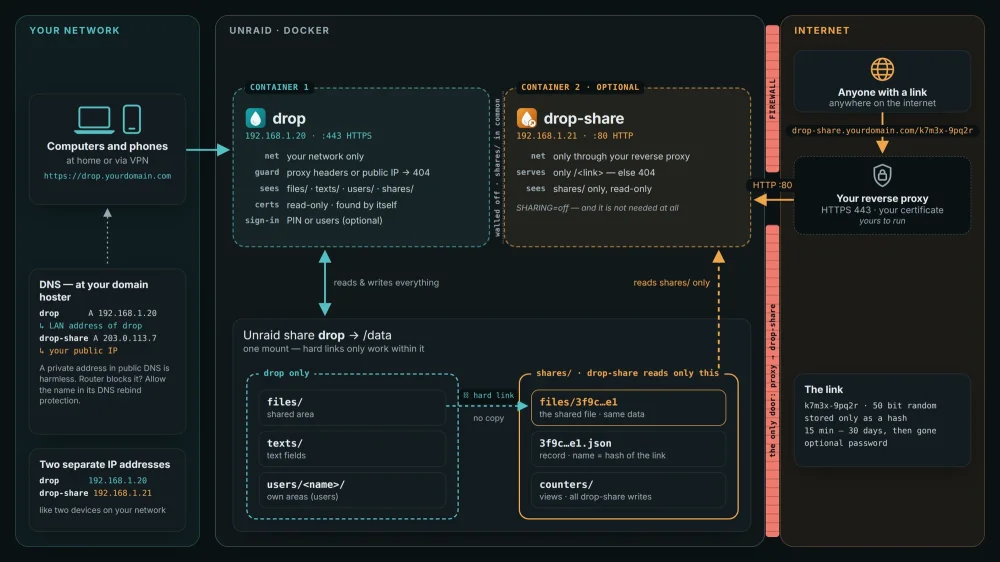
Hi everyone, Drop from Dropnook is instant sharing for your home network — like AirDrop, but for every device. Get a text or a file from your phone to your PC, from Windows to a Mac, from Android to an iPhone: open one web page, drop it in, and it is on every other device at once. No app, no login, no cloud — everything stays on your Unraid server. Made for your own LAN at home. On your devices it is simply Drop — the page calls itself “<server name> Drop”, after your server. Everything at a glance, with pictures: https://drop.dropnook.app/ What it does Text fields that survive reloads and lost connections; uploads of any size, resumable, with progress visible to everyone. Screenshots straight from the clipboard with Ctrl+V; pictures with preview, large view and Copy into the clipboard of another computer. Live room: video or voice for up to 10 people in your network — one click to join, no ringing. Picture and sound go straight from device to device; nothing leaves your network. Needs HTTPS and is meant for your private LAN only. Share to the internet: a single file or text through a link that expires by itself (15 minutes to 30 days), optionally with a password. Served by a second, locked-down container — Drop itself is never reachable from the internet. This is optional: it needs the Compose stack with its two separate containers. Optional users: up to five, each with a PIN, an area of their own next to the shared one, and their own colour. Two ways to run it — same image, pick what you need Community Applications — LAN only. Apps → search Dropnook → Install. One container (drop), reachable in your network only, sharing to the internet switched off. Give it its own address (Custom: br0 with a fixed IP) and open http://<that address>/, or use Bridge with the template’s port 8088. Create the share drop first (Shares → Add Share). For HTTPS — and so for the live room — enter a certificate (e.g. from Cert Warden) under Show more settings. Compose stack — with sharing to the internet. Two separate containers, drop and drop-share, each with its own LAN address, set up with the Compose Manager Plus plugin: Docker → Compose → Add New Stack → paste compose.yaml and the .env from the repo, fill in two free addresses, Compose Up. Your reverse proxy points at drop-share only; Drop finds your existing certificate (Nginx Proxy Manager’s folder is preset) and runs HTTPS in your network, too. Step by step: https://github.com/dropnook/drop#installation What Drop deliberately does not do: no folders (zip them), no recycle bin, no uploads from outside, no live room from outside your network. Updates: the image ghcr.io/dropnook/dropnook:2 follows every 2.x release; after an update every open Drop page reloads itself. Support: questions, problems and wishes here in this thread or as a GitHub issue: https://github.com/dropnook/drop/issues. German speakers: there is a German thread too. I have used Unraid for years — Drop is the tool I always missed for my own home network. Maybe it helps some of you, too. Cheers, Benj
-
Bleibt eigentlich nur noch das Elektrische... Netzteil oder Board. Netzteil tauschen wäre der nächste logische Schritt; wenn es damit weiter einfriert, bleibt das Board.
-
Thanks! Done.
-
Da stimme ich dir voll zu, deine Prototypen Bilder sind cool und helfen definitiv ja. Ich vermute dass Unraid 8 auch mehr in diese Richtung gehen wird. Und Unraid 7.4 bringt auch bereits Mover-Verbesserungen mit. Ich selber nutze für mehr Funktionen und Ansichten mein eigenes USO-Plugin das zeigt z.B. beim moven auch schöne Grafiken, den Speed und die Zeitprognose. Parity-Sync zeigt das aktuelle Unraid aber auch schon an im Tab Main unten, da fehlt mir eigentlich nichts.... Allgemein hat Unraid in letzter Zeit mega Fortschritte gemacht und solche Community Anfragen / Ideen wie von dir werden nicht selten aufgenommen.
-
Mover: files and folders whose name ends in a space are never moved (and a same-named neighbour can be moved instead) Seen on 7.4.0-rc.1, and the same move binary behaves this way on 7.3.3. The Mover seems to strip trailing whitespace from every path it reads on stdin. A file or folder whose name ends in a space (or tab) is then looked up without it, fails with «No such file or directory», and stays where it is. The mover still exits 0. With «Mover logging» disabled (the default) nothing is logged about it, so a share looks fully moved while some files are still on the pool. It gets worse when a file 'twin' sits next to 'twin ' asking for 'twin ' moves 'twin' instead. It only bites real trailing spaces (byte 0x20) in the name on the server. Names written by apps on the server have them: Nextcloud (synced from a Mac), containers, the terminal, NFS clients. In my case it was folders like '06 June ' inside a Nextcloud data share. A name with a trailing space made in the macOS Finder over SMB is not affected, because Samba stores the trailing space as U+F028, so such a folder moves fine.
-
Ganz genau :-) Danke dir und viel Spass beim weiteren Entwickeln. Ich werde hier weiter mitlesen.
-
Cool - Tools von Leuten gebaut die Erfahrung haben und wissen was es braucht. Ich habe jedoch schon lange kein Windows mehr und möchte es mir auch nicht mehr antun 😝 Die einfache Einrichtung und Nutzung eines zentralen Monitoring finde ich super, nur befürchte ich auch, dass die Fülle an User-Wünschen dann auch den Umfang sprengen könnte? Bei mir im Einsatz sind natürlich diverse Unraid Server, Ubiquiti Unifi und die typischen Home-Apps wie Nextcloud, Immich, Plex/Emby/Jellifin, Kopia (beste Backuplösung die ich kenne), Nginx Proxy Manager, Apache/Webseiten und versitygw als eigenen S3-Server. Im Kollegenumfeld von mir ist z.B. Mikrotik (Netzwerk) vertreten. Wichtig wäre sicher auch zu verstehen und zu sehen ob SSL Zertifikate bald ablaufen oder obsolet geworden sind, wobei ersteres Nginx eigentlich selber automatisieren kann. Von daher ja, Apps überwachen und alles was mit dem Netzwerk zu tun hat.
-
Hallo Meik Mega cooles Projekt! Darf ich fragen warum du es als Windows-Anwendung gebaut hast, anstatt als Docker? Und ob Ubiquiti Unifi vielleicht noch geplant ist neben OPNsense. 😃 Viele Grüsse Benj
-
Thank you!
-
Thanks for keeping it alive this long. The part of Enhanced Log that is hard to replace isn’t the pages, it’s syslog_match.conf. That is probably years of forum experience in one file. I maintain the Unraid Secretary Office (https://github.com/dropnook/UnraidSecretaryOffice, GPL-3.0-or-later). Its log desk, Ms. Protocolli, already reads the syslog, dmesg, Docker, libvirt, Samba, User Scripts, every container’s log and counts and groups errors and warnings. But what she doesn’t have is exactly your curated per-line classification and the highlighting. I’d like to take the rule set into her, keep it maintained there (with the credit to EDACerton and dlandon in the README, same as I do for helmi1987’s MediaCache ans SmartMover tools) and add maybe custom rules on top. If that’s fine with you ❔ , I’ll report back here when it’s in. That keeps the rules alive for people who install the Unraid Secretary Office Plugin; whether someone also wants to fork the standalone plugin for the CA listing is a separate question, and I won’t promise that.
-
Two things from your diagnostics first: parity is the 32 TB with serial …K1S1KNN6 (sdo) and it sits on an Intel port; disk1 is the other 32 TB (…K1S1L37P, sds), and that one is on the Marvell card. So moving disk1 off the card is right, parity doesn’t need to move? On skipping the rebuild: the “write error” at 06:07 was Unraid’s own read-error correction (it reconstructed the four sectors from parity and tried to write them back, that write failed, hence the disable), so it doesn’t look like anything of yours was written to the emulated disk11 before the array stopped at 06:21; the physical disk is very likely identical to what parity emulates. Even so, I’d rebuild rather than New Config: a rebuild rewrites one 18 TB disk from parity, so you don’t have to trust that the physical disk11 matches what parity emulates; New Config takes the disk as it is and then needs a full parity sync over all 17 disks, which takes longer. If disk11’s SMART is clean after the reboot, rebuild it onto itself: Stop, set disk11 to “no device”, Start, Stop, assign it again, Start. Replace the card first, so the rebuild doesn’t run through it. Hopefully you still have a backup just in case—there are a lot of disks....🤔
-
Hast du es mittlerweile selber geschafft oder brauchst du noch Hilfe?
-
Passt so. “Power Supply Idle Control” musst du nicht weiter suchen: Sie verhindert nur den tiefen Leerlaufzustand, der manche Netzteile stört, und den hast du mit “Global C-state Control = Deaktiviert” bereits abgeschaltet. CLDO VDDP/VDDG auf Auto lassen, da gibt es nichts einzustellen. Jetzt ein, zwei Tage so laufen lassen: bleibt er stabil, war es das; friert er wieder ein, kommt das Netzteil dran oder weiter suchen....
-
Your syslog shows disk11 (the WD 18 TB on sdr) stopped answering at 20:18 last night, about 27 minutes into the clear of the new disk: timeouts, “failed to IDENTIFY”, then the kernel disabled the device. No CRC errors, the drive simply vanished from the bus, so SMART couldn’t be read either. The red X only came at 06:07 when the array next touched it. Disk11 sits on the Marvell 88SE9215 card together with the new disk that was being cleared and disk1; Marvell cards are known to drop disks under load, so my guess is the card, not the drive. JorgeB will no doubt confirm or correct that and give you the exact steps; in the meantime: reboot, check disk11’s SMART, and don’t run the clear and a rebuild through that card at the same time.