






TexasDave
Members
-
Joined
-
Last visited
-
Replacing two old cache SSDs in Unraid (what worked for me) Why I did this My cache pool was running on two Samsung 850 EVO 500GB SSDs that were close to 10 years old. They were still working, but given their age I wanted to replace them proactively before a failure, while keeping the cache pool and data intact. My setup Unraid 7.2.3 Cache pool: Btrfs, RAID1 Old drives: 2 × Samsung 850 EVO 500GB New drives: 2 × Samsung 870 EVO 500GB SATA hot-plug enabled in BIOS I did not shut the server down at any point during this process. All drive swaps were done live. Before starting (important) Before touching any disks, I ran an Appdata Backup using CA Backup/Restore. Nothing went wrong, but having a current backup made the whole process much less stressful. What I expected (and what didn’t work) I expected to be able to hot-swap each old SSD with a new one using Unraid’s Replace function. Instead, when I tried to replace the first drive, Unraid failed with an error like: Wrong Pool State – replacement device too small Even though both drives were advertised as 500GB, Unraid compares usable size, not marketing size, and the replacement was rejected. What actually worked (important part) This is not a true “replace”. It’s a remove → re-add process. I did this one drive at a time. First drive Stop the array Physically remove one old cache SSD (hot-swap, server stayed on) Start the array Unraid reports a missing cache pool device Check the box to remove the missing pool disk Stop the array again Set Cache Slots = 2 Unraid drops this to 1 automatically, which is easy to miss Assign the new SSD to the empty cache slot Start the array Let Btrfs balance run (it started automatically for me – do not interrupt it) Verify RAID1 with: btrfs filesystem df /mnt/cache Do not proceed until Data, Metadata, and System all show RAID1. Second drive Once RAID1 was fully restored, I repeated the exact same steps for the second old SSD. How I verified success After each replacement, I ran: btrfs filesystem df /mnt/cache The final, correct state for my setup was: Data, RAID1: total=69.00GiB, used=67.36GiB System, RAID1: total=32.00MiB, used=16.00KiB Metadata, RAID1: total=2.00GiB, used=375.28MiB GlobalReserve, single: total=120.09MiB, used=0.00BThe Unraid UI showed “Pool of two devices” with both new SSDs. Key takeaways Same advertised size does not guarantee a cache replacement will work If you see “replacement device too small”, remove the old device first, then add the new one Do not start the second replacement until btrfs filesystem df /mnt/cache shows Data, Metadata, and System as RAID1. Watch the cache Slots setting – it will trip you up if you miss it Let Btrfs balance finish before doing anything else If hot-plug is enabled, this can be done without shutting the server down This was done after I did this so my instructions may not be perfect but hopefully they help...Thanks!
-
OK - I did get it working. Before I got as far as above, I did have to download the yml file - the docker template does not do that. I also tweaked a bunch of settings in the Komf docker - but not sure if that mattered or not. I did get it to work on Chrome first - using the extension. And then on Firefox (my main broswer). It is very hard to see the "jigsaw" icon as it is white. So maybe it was working for sometime? The final fix is once you get the jigsaw, there is a Komf setting in Komga - and I had to change the entry from local host to my actual local IP.
-
I have both the Komga and Komf dockers installed. They both seem to be working fine and they look to be talking to each other. But I am not seeing the Komf controls injected into my Komga pages. I have tried on both Chrome and Firefox. I am using the browser extensions as the script says it has been deprecated? in looking at the console messages (in chrome) I see: Failed to fetch chrome-extension://aeblfdkhhhdcdjpifhhbdiojplfjncoa/inline/injected.js, Import failed 3 times. Final error: window.crypto.randomUUID is not a function S @ inject-content-scripts.js:5Understand this error This may have nothing to do with my error? I have goofled and I see some folks saying there are issues using http rather than https? But I am running these dockers local under http? Thanks for any help....
-
Many thanks for your work on this and other dockers - THANKS! I am running privoxyvpn with PIA and using strict port forwarding and openvpn. Two questions: Is there a web GUI for the actual privoxyvpn docker? I assume this (http://config.privoxy.org/) is not it and I need to update it in my docker setup? My GUIs to the dockers running through privoxyvpn are all good. I am assuming local host or my Unraid IP with the correct port? I would stop it to try but that leads me to (2).... I am using PIA and running several dockers through privoxyvpn. One of these is deluge (not deluge VPN). I note that to get this fully connected to the service it is using I need to go into the preference in Deluge client and change the port from 58946 to the port that shows up in the privoxyvpn logs. I think I understand why but would like to understand. PIA must "randomly" (??) give a port and the service ports that we input when setting up the privoxyvpn are just used to route in the Unraid VPN network we created? Will I need to look in the logs every time I restart privoxyvpn to check on the port to use for the Deluge client? I may be totally lost or explaining it poorly. Many thanks for any clarity you can provide! Happy holidays to all!
-
That looks great - is there any similar solution for iOS, Android, Linux or Windows?
-
This was a super helpful post - THANK YOU!
-
You have been a big help - no worries at all. And the plugin is much appreciated. Question: I assume I can still use my UPS short term? It will just supply power if I lose power but does not have any smarts so unRAID will not shutdown. So all it does now is keep it up and running and I have to hope the power comes back on before it runs out of charge?
-
The cables seem fine. I can plug them into a printer and a Windows laptop sees them... I strongly suspect the usb port on the actual UPC - it seems very "loose" - not sure how that happened. May be time for a new UPS. 😞
-
NUT Debug Package also attached n ow - sorry - I missed that out. I agree with your assessment - I do not think the USB connection is being picked up. Will see if I can get the UPS and USB cable to be recognized by a windows - Thanks! nut-debug-20240309210916.zip
-
I have had NUT working fine for some time. But to be fair, have not looked for a month or two too see if it was working and had no warnings or alerts. I had to move my server today as we are painting and noticed when bringing it back up, it has stopped working. My UPC is a APC BX700U Series. Motherboard is Supermicro X10SL7-F The APC UPS daemon is NOT activated I have tried two different USB cables and 3 different USB ports. I have ordered a new cable and will try that. I have tried both the current version and the 2.7.4 version (with restart) I am attaching my diagnostics. Here is what I am getting in the SYSLOG: Mar 9 16:42:28 Zack-unRAID root: Writing NUT configuration... Mar 9 16:42:30 Zack-unRAID root: Updating permissions for NUT... Mar 9 16:42:30 Zack-unRAID root: Checking if the NUT Runtime Statistics Module should be enabled... Mar 9 16:42:30 Zack-unRAID root: Enabling the NUT Runtime Statistics Module... Mar 9 16:42:31 Zack-unRAID root: Network UPS Tools - Generic HID driver 0.55 (2.7.4.1) Mar 9 16:42:31 Zack-unRAID root: USB communication driver 0.43 Mar 9 16:42:31 Zack-unRAID root: No matching HID UPS found Mar 9 16:42:31 Zack-unRAID root: Driver failed to start (exit status=1) Mar 9 16:42:31 Zack-unRAID root: Network UPS Tools - UPS driver controller 2.7.4.1 Mar 9 16:45:56 Zack-unRAID pulseway: First reporting data collection finished Mar 9 16:51:00 Zack-unRAID root: Fix Common Problems Version 2024.02.29 Mar 9 16:52:02 Zack-unRAID ool www[14520]: /usr/local/emhttp/plugins/nut-dw/scripts/start Mar 9 16:52:03 Zack-unRAID root: Writing NUT configuration... Mar 9 16:52:05 Zack-unRAID root: Updating permissions for NUT... Mar 9 16:52:05 Zack-unRAID root: Checking if the NUT Runtime Statistics Module should be enabled... Mar 9 16:52:05 Zack-unRAID root: Enabling the NUT Runtime Statistics Module... Mar 9 16:52:06 Zack-unRAID root: Network UPS Tools - Generic HID driver 0.55 (2.7.4.1) Mar 9 16:52:06 Zack-unRAID root: USB communication driver 0.43 Mar 9 16:52:06 Zack-unRAID root: No matching HID UPS found Mar 9 16:52:06 Zack-unRAID root: Driver failed to start (exit status=1) Mar 9 16:52:06 Zack-unRAID root: Network UPS Tools - UPS driver controller 2.7.4.1 Here is what I am getting in NUT USB Diagnostics... ### ### USB DEVICES ### Bus 002 Device 002: ID 8087:8000 Intel Corp. Integrated Rate Matching Hub Bus 002 Device 001: ID 1d6b:0002 Linux Foundation 2.0 root hub Bus 001 Device 002: ID 8087:8008 Intel Corp. Integrated Rate Matching Hub Bus 001 Device 001: ID 1d6b:0002 Linux Foundation 2.0 root hub Bus 004 Device 001: ID 1d6b:0003 Linux Foundation 3.0 root hub Bus 003 Device 004: ID 0557:2419 ATEN International Co., Ltd Virtual mouse/keyboard device Bus 003 Device 003: ID 0557:7000 ATEN International Co., Ltd Hub Bus 003 Device 002: ID 0781:5571 SanDisk Corp. Cruzer Fit Bus 003 Device 001: ID 1d6b:0002 Linux Foundation 2.0 root hub ### ### USB DEVICES (TREE VIEW) ### /: Bus 04.Port 1: Dev 1, Class=root_hub, Driver=xhci_hcd/2p, 5000M ID 1d6b:0003 Linux Foundation 3.0 root hub /: Bus 03.Port 1: Dev 1, Class=root_hub, Driver=xhci_hcd/10p, 480M ID 1d6b:0002 Linux Foundation 2.0 root hub |__ Port 1: Dev 2, If 0, Class=Mass Storage, Driver=usb-storage, 480M ID 0781:5571 SanDisk Corp. Cruzer Fit |__ Port 7: Dev 3, If 0, Class=Hub, Driver=hub/4p, 480M ID 0557:7000 ATEN International Co., Ltd Hub |__ Port 1: Dev 4, If 0, Class=Human Interface Device, Driver=usbhid, 1.5M ID 0557:2419 ATEN International Co., Ltd Virtual mouse/keyboard device |__ Port 1: Dev 4, If 1, Class=Human Interface Device, Driver=usbhid, 1.5M ID 0557:2419 ATEN International Co., Ltd Virtual mouse/keyboard device /: Bus 02.Port 1: Dev 1, Class=root_hub, Driver=ehci-pci/2p, 480M ID 1d6b:0002 Linux Foundation 2.0 root hub |__ Port 1: Dev 2, If 0, Class=Hub, Driver=hub/6p, 480M ID 8087:8000 Intel Corp. Integrated Rate Matching Hub /: Bus 01.Port 1: Dev 1, Class=root_hub, Driver=ehci-pci/2p, 480M ID 1d6b:0002 Linux Foundation 2.0 root hub |__ Port 1: Dev 2, If 0, Class=Hub, Driver=hub/4p, 480M ID 8087:8008 Intel Corp. Integrated Rate Matching Hub ### ### USB POWER MANAGEMENT SETTINGS ### ON: ALWAYS ON / AUTO: SYSTEM MANAGED ### ==> /sys/bus/usb/devices/1-1/power/control <== auto ==> /sys/bus/usb/devices/2-1/power/control <== auto ==> /sys/bus/usb/devices/3-1/power/control <== on ==> /sys/bus/usb/devices/3-7.1/power/control <== on ==> /sys/bus/usb/devices/3-7/power/control <== auto ==> /sys/bus/usb/devices/usb1/power/control <== auto ==> /sys/bus/usb/devices/usb2/power/control <== auto ==> /sys/bus/usb/devices/usb3/power/control <== auto ==> /sys/bus/usb/devices/usb4/power/control <== auto ### ### USB RELATED KERNEL MESSAGES ### [ 0.381770] usbcore: registered new interface driver usbfs [ 0.381877] usbcore: registered new interface driver hub [ 0.381986] usbcore: registered new device driver usb [ 0.425339] pci 0000:00:1a.0: quirk_usb_early_handoff+0x0/0x63b took 16379 usecs [ 0.442337] pci 0000:00:1d.0: quirk_usb_early_handoff+0x0/0x63b took 16475 usecs [ 1.988551] usbcore: registered new interface driver usb-storage [ 1.988989] usbcore: registered new interface driver synaptics_usb [ 1.991126] usbcore: registered new interface driver usbhid [ 1.991234] usbhid: USB HID core driver [ 2.208343] usb 1-1: new high-speed USB device number 2 using ehci-pci [ 2.224346] usb 3-1: new high-speed USB device number 2 using xhci_hcd [ 2.224470] usb 2-1: new high-speed USB device number 2 using ehci-pci [ 2.352117] usb-storage 3-1:1.0: USB Mass Storage device detected [ 2.352581] scsi host0: usb-storage 3-1:1.0 [ 2.466334] usb 3-7: new high-speed USB device number 3 using xhci_hcd [ 2.890359] usb 3-7.1: new low-speed USB device number 4 using xhci_hcd [ 3.002104] input: HID 0557:2419 as /devices/pci0000:00/0000:00:14.0/usb3/3-7/3-7.1/3-7.1:1.0/0003:0557:2419.0001/input/input1 [ 3.054596] hid-generic 0003:0557:2419.0001: input,hidraw0: USB HID v1.00 Keyboard [HID 0557:2419] on usb-0000:00:14.0-7.1/input0 [ 3.056387] input: HID 0557:2419 as /devices/pci0000:00/0000:00:14.0/usb3/3-7/3-7.1/3-7.1:1.1/0003:0557:2419.0002/input/input2 [ 3.057039] hid-generic 0003:0557:2419.0002: input,hidraw1: USB HID v1.00 Mouse [HID 0557:2419] on usb-0000:00:14.0-7.1/input1 My concern is it the the USB ports on my server or the USB port into the UPC. Ideas on what else I can do to try to debug and/or fix this? zack-unraid-diagnostics-20240309-1631.zip
-
Thanks for the help - much appreciated!
-
Hello, During my usual monthly parity check, I received some read errors concerning one of my parity drives: Event: Unraid array errors Subject: Warning [ZACK-UNRAID] - array has errors Description: Array has 1 disk with read errors Importance: warning Parity disk - WDC_WD60EFRX-68MYMN1_WD-WX51DA47619X (sdd) (errors 256) After the parity check completed, I ran a smart disk extended test on the parity drive but all seemed fine. See attached. This morning I received another warning about this drive. I fear the end is near: Event: Fix Common Problems - Zack-unRAID Subject: Errors have been found with your server (Zack-unRAID). Description: Investigate at Settings / User Utilities / Fix Common Problems Importance: alert * **parity (WDC_WD60EFRX-68MYMN1_WD-WX51DA47619X) has read errors** I attach the smart drive tests and my unRAID server data. Is there anything I can do to either confirm the drive is close to failing or that these errors are anomalies? The drive in question is old...Thanks! zack-unraid-smart-20230806-1150.zip zack-unraid-diagnostics-20230806-1152.zip
-
All the stuff on disk 4 was old. I just backed it up (actually renamed it OLD) just in case. Turned off dockers, updated config info, and all seems to be working. Many thanks both!!
-
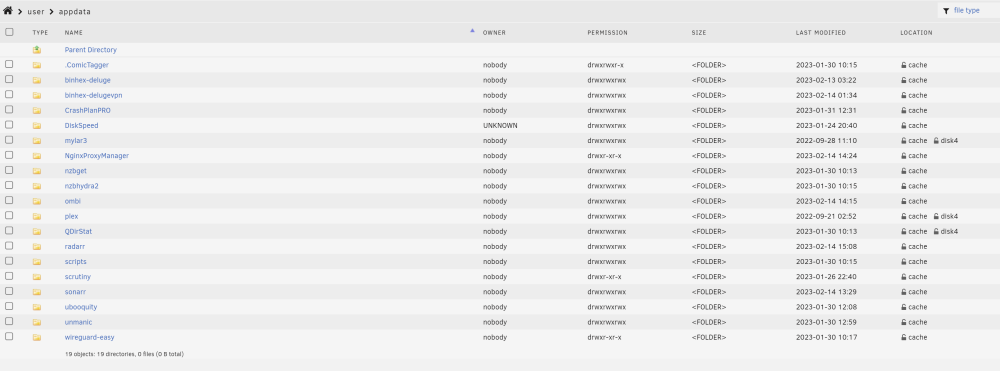
Thank you! There is a tiny bit on Disk 4... Can I do the following: 1) Stop the three dockers 2) Move the appdata from disk4 to cache 3) Edit three dockers, change them to use cache. 4) Start dockers? Or is there a better way? It is weird as the three dockers (mylar3, plex and QDirSTat) should be using cache? Maybe that is old stuff? Thanks!!


-
Just wondering if anyone has any advice on this please?




