





dnLL
Members
-
Joined
-
Last visited
Everything posted by dnLL
-
How to disable the yellow bar alert that says I need to reboot my server? I hit the disable button and then re-enabled it immediately since I don't want to reboot and want to get rid of the message. I tried removing the plugin but that yellow alert is still there and there is no X.
-
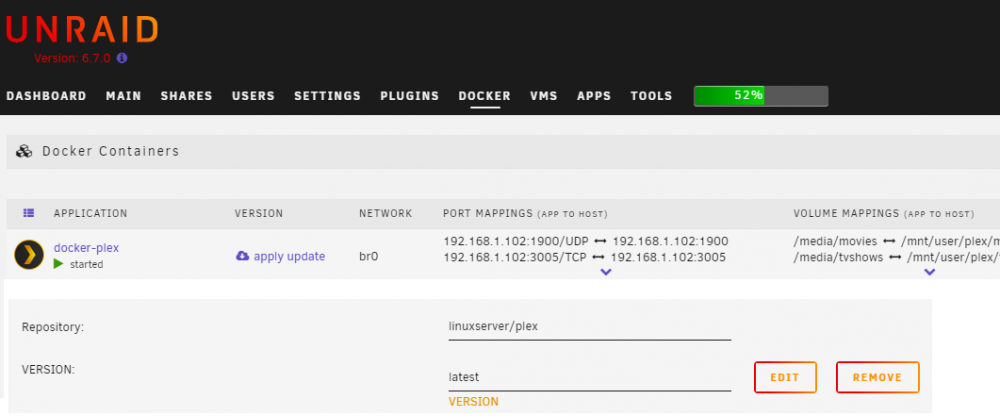
Not really the end of the world but unRAID keeps saying there is a new update for this Plex docker even if I just updated it. Sorry if this has been discussed previously (didn't find it).
-
Not sure why I didn't read about this before but I've just set it up (takes 30 seconds to do) and tested it and it works perfectly. Transcoding a 1080p movie to 480p on a poor connection with the server's IGP (some Intel HD something integrated into my Xeon E3-1245 V6) and it took about ~30MB of space on the FS... which translated to +30MB of RAM used too. As soon as I stopped the playback, the files were deleted. I'll test it for a while and as long as Plex keeps deleting its transcoding cache, this should be fine. CPU is usually around ~120% when transcoding with the GPU (or like 12% in the webUI, it's a 4c8t CPU). Without GPU transcoding it would usually gobble all 8 threads immediately until it throttled a little bit. I added another extra parameter to the docker to make sure it never takes more than 75% of my CPU: --cpus=6.
-
Thanks for the quick reply and fixing the support thread for your docker. Since I don't see any reason to use a docker only to run a ~40ish lines script, I won't use it, but for people less at ease with programming, I can see the ease of use of just clicking buttons in the UI being helpful for them.
-
Not sure if normal but this is where I get redirected when clicking the support thread for the godaddy ddns docker. I was wondering if you were doing anything special since I've modified some script I found on the web and run it with cron and it gets the job done. #!/bin/bash keys=(key1 key2) secrets=(secret1 secret2) domains=(domain1 domain2) Type=A Name=@ TTL=600 CachedIP=/tmp/current_ip CheckURL=http://api.ipify.org echo -n "$(date +%Y%m%d%H%M%S) Checking current 'Public IP' from '${CheckURL}': " PublicIP=$(curl -kLs ${CheckURL}) if [ $? -eq 0 ] && [[ "${PublicIP}" =~ [0-9]{1,3}\.[0-9]{1,3} ]]; then echo "${PublicIP}." else sleep 120 PublicIP=$(curl -kLs ${CheckURL}) if [ $? -eq 0 ] && [[ "${PublicIP}" =~ [0-9]{1,3}\.[0-9]{1,3} ]]; then echo "[retry] ${PublicIP}." else echo "[retry] Fail! ${PublicIP}" exit 1 fi fi if [ "$(cat ${CachedIP} 2>/dev/null)" != "${PublicIP}" ]; then for ((i = 0; i < ${#domains[@]}; ++i)); do echo -n "$(date +%Y%m%d%H%M%S) Checking '${domains[$i]}' IP records from 'GoDaddy': " Check=$(curl -kLsH"Authorization: sso-key ${keys[$i]}:${secrets[$i]}" -H"Content-type: application/json" https://api.godaddy.com/v1/domains/${domains[$i]}/records/${Type}/${Name} 2>/dev/null|jq -r '.[0].data')>/dev/null if [ $? -eq 0 ] && [ "${Check}" = "${PublicIP}" ]; then echo -e "unchanged.\n$(date +%Y%m%d%H%M%S) Current 'Public IP' matches 'GoDaddy' records. No update required." else echo -e "changed.\n$(date +%Y%m%d%H%M%S) Updating '${domains[$i]}' from '${Check}' to '${PublicIP}'." Update=$(curl -kLsXPUT -H"Authorization: sso-key ${keys[$i]}:${secrets[$i]}" -H "Content-type: application/json" https://api.godaddy.com/v1/domains/${domains[$i]}/records/${Type}/${Name} -d "[{\"data\":\"${PublicIP}\",\"ttl\":${TTL}}]" 2>/dev/null) if [ $? -eq 0 ] && [ "${Update}" = "" ]; then echo "$(date +%Y%m%d%H%M%S) Success." else echo "$(date +%Y%m%d%H%M%S) Fail. ${Update}" exit 1 fi fi done echo ${PublicIP}>${CachedIP} else echo -en "$(date +%Y%m%d%H%M%S) Current 'Public IP' matches 'Cached IP' recorded. No update required.\n" fi exit $? I'm trying to understand in what use case scenario would a docker be a better solution than a simple 40ish lines script (could probably be optimized to < 30 lines).
-
That's probably out of topic a little bit but I use Check_MK to keep stats on all my dockers/VMs/servers so I do need the API if I want a nice chart over 400 days of active tunnels and activity. With the wg command I can easily make a local check in shell or bash. Edit: Just realized I need 6.8 to get this working, I'm still under 6.7 with over 200 days of uptime. I will wait a little bit but will definitely try it.
-
Seems like there is extra setup required to be able to properly connect to dockers from the VPN with Wireguard, which just shows how clueless I am about networking in general since I don't understand how different it is exactly from my current setup. You are right though, I should give it a try. I assume there is an API that comes with Wireguard to monitor who is connected or the number of connections? I will give it a look.
-
For this to work you do have to forward one port from your router directly to your unRAID server. It's been established in the past that it's better not to forward any port to your unRAID server because unRAID was never really built around security. Did I misunderstand something or did something change? Aside from performances (and assuming this is not an issue), what are the advantages of using Wireguard instead of a dedicated docker/VM with OpenVPN/Softether where you can get better isolation from your unRAID server? Also I'm no network expert but I have a Softether server installed in a Windows VM and never had to add any rule to my router besides forwarding 1 port to that VM and my dockers are perfectly accessible from the VPN. My router is still the DHCP server within that VPN tunnel so the peripheral jsut behaves like anything else on the local network (which is, from my perspective, what people usually try to achieve with VPN).
-
Has anyone updated to 6.7.1 or 6.7.2 and can confirm that this still works properly for the new zombieland vulnerability? I assume everything is fine looking at cybrnook's post.
-
Honestly, getting 2 or 3% on average is already a lot in my book and enough to bother. People overclock and sometimes stress their components a lot for barely more than that. Getting more than that in some specific scenarios is just a nice bonus.
-
I'm also interested in this question since most motherboard manufacturers have provided updated version of their BIOS following Spectre. If it's at the motherboard level then how can the OS interact with this? There is definitely a detail we're missing here.
-
I just checked and everything I need is in the BIOS so I'll go with the SmartFan options (with a more agressive profile than default). Can't say the BIOS is the most user friendly but it works. I'll keep an even more aggressive version of the settings within the plugin so that I can enable it if I'm doing anything crazy.
-
I'd need to take a look at the BIOS options again but last time I checked only the CPU fan would go faster according to CPU temps, not the chassis fans. The issue I have is I need to reboot to get to the BIOS in the first place, whereas with a software plugin such as yours I can edit settings on the fly.
-
All right well I changed my non-PWM S12b for a F12 (can't go wrong staying with Noctua) and it works (and it's also a huge improvement, I have an ITX case with restricted airflow). Question 1) I was wondering, is there any disadvantage of having a lower temperature polling time value? 3 minutes seems kinda slow, if my CPU is idle and suddenly has a big encoding workload I definitely don't want it to wait 3 minutes until the fans adjust. I was thinking of 30 seconds. Question 2) If I manually set up speeds according to CPU temperatures, does it completely ignore HDD temperatures? Question 3) Any performance disadvantage of using the plugin instead of whatever the BIOS/BMC would do by itself? As in, is there a dedicated chip on the motherboard that would usually do that instead of using CPU resources (assuming your plugin does in fact use the CPU to poll the temperatures).
-
Does this plugin support non-PWM fans? Since you can still control their speed through voltage usually. My regular fan speed is detected at 700 rpm (silent mode in BIOS) but the auto-configuration doesn't see it. I have an ASRock Rack board.
-
Honestly, it was kinda implicit by "I don't have anything important" that my data (which is basically just my Plex library) is definitely not a big target for this attack. Not to consider that I need to connect to my VPN to even reach my Plex. If the NSA or the equivalent in Canada (the CSIS, we like them with 4 letters in Canada) want to know which movies I'm watching, I couldn't care less (except for the part where my money is paying them to watch me but that's another debate).
-
Thanks. So depending on the workload, it can be a small or a big difference, but it's always a positive difference nevertheless. Well, thanks for the plugin, I just enabled it, will reboot tomorrow. Don't need the security fixes at all personally, I don't have anything that important.
-
Has anyone run any sort of benchmark on this? I'm just legitimately curious.
-
And libvirt.img being on the array in ./system, losing the flash drive doesn't matter. Is there any reason to backup the full 1GB libvirt.img over just saving what's in /etc/libvirt? The actual content of that FS is very small in comparison to the 1GB IMG container. root@server:~# du -sh /etc/libvirt/ 1.0M /etc/libvirt/ root@server:~# ls -l /lib/virt/ /bin/ls: cannot access '/lib/virt/': No such file or directory Also you mentionned /lib/virt, not sure if there is anything supposed to be in there.
-
Hi all, I have a Duplicati docker taking care of my backups currently and I'm trying to have everything centralized at the same place as much as possible isntead of using different plugins to back up different things. So, Duplicati backs up all my vdisks already and I'm trying to configure it to take care of my VM settings (XML and nvram). So, I configured it for /etc/libvirt/qemu/ with some exclusions and it works for the nvram subfolder but not for the XMLs themselves. I noticed the permissions on the XMLs are set to 600 while the nvram files are 666 so I assume that's the issue here. Now, before changing permissions to the XML files to 644, I have some questions: Are the XMLs and nvram files in /etc/libvirt/qemu regenerated after each reboot or do changes in that folder magically stay permanent even after a reboot? (1a) If files are permanent, are permissions persistant? What about new XMLs? What would be the best approach? (1b) If files are regenerated, I could have User Script run a script to change permissions to 644 every month before Duplicati takes that backup; are there any insensitive in not changing the XML file permissions? Thank you.
-
Funnily enough after pinning all my VMs to a full core, some switched their topology correctly to 1c2t, others still had 2c1t. Not sure how the webUI handles all of this when not using the XML form format.
-
Sorry, that probably wasn't very clear. Basically OS handle threads differently if they belong to the same core, but for VMs it's usually just vCPUs without any way for the VM to know if the 2 threads are from the same core or not. I saw some "hacks" (ie. not limiting yourself to the unRAID webUI) to basically make sure the VM would properly use the 2 threads as a full core with HT rather than 2 distinctive threads from 2 separate cores.
-
In fact I have 7 VMs and 1 docker. Some of the VMs barely use 100MB of RAM and any CPU at all, they could be in dockers in fact but that's another debate. I made some changes now, having all my VMs using a full core with its hyper thread. Core 0 (with HT) is pinned to nothing, Core 1 (with HT) is pinned to my two most important VMs (still light workload), Core 2 (with HT) is pinned to a VM with a higher workload and Core 3 (with HT) is pinned to my last 3 VMs which aren't that important. This way unRAID has Core 0 for itself. Now as for my Plex docker, I used something I don't see suggested at all in the FAQ and it's the --cpus=6 parameter, which gives access to 75% (6/8) of every core/thread rather than locking the docker to specific cores/threads. So assuming my Plex docker is doing very hard work, it will never use more than 75% per core, leaving at least 25% of a full core to the VMs and to unRAID itself. I think I'm covering most of my workload possibilities this way after doing some quick tests (obviously if Plex is taking 75% of everything and a VM needs its full core, they will challenge each other for CPU resources but it's fine). One last question as I was reading from some old posts that the VM couldn't know if its 2 vCPUs were a HyperThread core or just 2 random cores/threads. People were adding parameters to their XMLs to make sure KVM let the VM know it's a core with HT. Is that still necessary?
-
Sorry if this has already been asked, I couldn't find an answer (please point me in the right direction if there is one available); I have a 4-core CPU with HT, so 8 threads total. Most of my VMs have VERY light workload and would be totally fine with 1 hyperthreading thread without needing the full core. In fact, it's been working that way for a while until I decided to question whether it was optimal or not. Let's say I have 10 VMs with the following CPU pinnings: VM 1: vCPU 0, 4 VM 2: vCPU 0, 4 VM 3: vCPU 1, 5 VM 4: vCPU 1, 5 VM 5: vCPU 2 VM 6: vCPU 3 VM 7: vCPU 6 VM 8: vCPU 7 VM 9: vCPU 7 VM 10: vCPU 7 Is there anything wrong here, assuming the VMs sharing the same vCPU never really use more than ~10% load, or is assigning a HyperThreading core to a VM without assigning the full core simply wrong (and why)?
-
I'm really curious about this. How does it work? I'd like some more technical network advice. If the VM is the only router, how do the different peripherals still communicate between each other when unRAID is turned off? Let's say it's a 4-port PCI card with 1 port set as WAN and the 3 other as LAN. The WAN port has the modem, 2 of the LAN ports have the IPMI interface and unRAID (motherboard NIC) and the last one has the only other computer. How can that computer communicate with the IPMI interface if the tower is shut down, can communication actually go through the PCI NIC even though it doesn't have power? I'm confused.

