





opentoe
Members
-
Joined
-
Last visited
Everything posted by opentoe
-
I already have an 18TB as my parity. I installed that several weeks ago knowing I would be doing this. Parity was rebuilt with no errors.
-
The status that I am at now is I cleared out one 4TB drive. Good. Then I installed the new 18TB without removing any drives yet. When unraid started a pre-clear automatically started. I did not install a pre-clear plugin, but when I selected TOOLS / DISK UTILITIES I clicked on PRECLEAR DISK and would of though I'd see the preclear going there. I do not. Right now all I see is on my dashboard upper right corner is some preclear information. It indicates it will take 17 hours to complete. I'm not sure I want to wait that long. Honestly I haven't done a preclear in ages. I guess I'm walking on ice. Does everyone still perform preclears? Also the preclear that is running, this obviously kicked off by itself, is there a way to cancel it and not have unraid keep trying to preclear it? I mean if I have to wait, no big deal, just a little impatient to get this little upgrade done. Once this new disk is all ready I will run unbalance again and utilize the new drive to dump the old 4TB drives out.
-
I've used it a couple of times on 6.9.2 with no issues. Retiring a couple old drives so I chose this tool. It has been working great since the first move. I'm so tired of mechanical drives. Eventually everything will be in a cloud or locally like an SSD. I doubt I'll be alive to see it happen. Disk moves/copies take forever!
-
What would your recommendation be to use for the moving files off the 4TB drives? I see the data I need to move on disk shares but am not sure that would screw up parity moving from disk share to disk or disk to array.
-
I guess I have this notion in my mind I cannot remove 2 drives that have data on them. If I need to empty them first, no problem. Using a terminal and MC is the quickest. But to confirm, they do have to be empty prior to removing them, correct? And thank you Jon.
-
I came across another 18TB Gold drive which I want to add to the array. But I want to also remove 2 or 3 old 4TB drives I have installed. I know this isn't going to take a second, but what suggestions would anyone have to do this the quickest way? Since I cannot remove 2 data drives at once I was going to remove 1 4TB drive, let the system rebuild. Then remove another, let the system rebuild, and then once more, remove another 4TB, let the system rebuild. That's 3 parity checks which usually take 24 hours each, so apparently this is going to take a long time. After the 4TB drives are out then I'll just install the 18TB and no parity check at that time. There isn't any possible way to remove 2 data drives at a time, right? What if I was to move all the data off of them using a stable move command or a plugin like UNBALANCE if it still works. Then the parity check will be pretty quick since there would be no data on those drives anyway, correct?
-
Thanks, understood
-
I am thinking about running this utility on 6.9.2, but not entirely it would work. I haven't see any development since last March I think that was, maybe the dev team is slowdown? There are always new features and plugins unraid can have to make it more available for the user. Even the dumb ones. I'm not even going to try and use unbalance until it has proven to work. I swapped so many drives around some are completely empty and some are bustout out! Anyone here use UNBALANCE for server version 4.76.1. So they can put the same amount of space on all the drives? I think it is more efficient that way.
-
Thanks. So when the array reboots this information gets cleared since it is not saved on the boot drive?
-
I only bring this up because I keep file activity on all the time and the tons of information is there, but my log system never really increases. Thanks for the info.
-
On the dashboard, flash, ram, log, and docker. How are these numbers calculated? For instance my log is at %3, how is unraid determining this? Thanks-
-
I am not a MAC guy at all. I would be able to install these Apps on my Apple TV 4v as an app?? Try to force the audio through. I believe when I was testing my hardware I forced direct audio as well and then when transcoding it worked. I would suspect any 1Gb player would work fine, that's why I keep fooling around with my $200 Apple 4k TV device. I've been waiting for about 20 hours not touching my array since it is on the last leg of my parity build. I can't do much with the server until that's all done. This is a great site with many samples! I'll be testing out my hardware for sure after my parity build
-
Sure, no problem. Would anyone know of a way to create a video file that has a constant bitrate around 90-100? All that's really needed is 10 to 15 minutes. I should have thought of this earlier. Go to the Jellyfish site and grab at least the 100 rate files and try them out. I just tried to play them all and so happens the Dune was the only player to play from start to finish with no issues. Video test files!
-
I would check the physical connections and cabling. Many of the drives I saw had UDMA_CRC_Error_Count and not just 1 or 2. I saw one drive that had over 100000. I also saw a couple drives that had very high read error rates. 1 Raw_Read_Error_Rate POSR-- 074 064 006 - 25790154 UDMA error count example smartctl 7.1 2019-12-30 r5022 [x86_64-linux-5.10.28-Unraid] (local build) Copyright (C) 2002-19, Bruce Allen, Christian Franke, www.smartmontools.org === START OF INFORMATION SECTION === Model Family: Toshiba 3.5" DT01ACA... Desktop HDD Device Model: TOSHIBA DT01ACA300 Serial Number: 37341WEAS LU WWN Device Id: 5 000039 fe6cff010 Firmware Version: MX6OABB0 User Capacity: 3,000,592,982,016 bytes [3.00 TB] Sector Sizes: 512 bytes logical, 4096 bytes physical Rotation Rate: 7200 rpm Form Factor: 3.5 inches Device is: In smartctl database [for details use: -P show] ATA Version is: ATA8-ACS T13/1699-D revision 4 SATA Version is: SATA 3.0, 6.0 Gb/s (current: 6.0 Gb/s) Local Time is: Sat Apr 9 13:10:49 2022 CEST SMART support is: Available - device has SMART capability. SMART support is: Enabled AAM feature is: Unavailable APM feature is: Disabled Rd look-ahead is: Enabled Write cache is: Enabled DSN feature is: Unavailable ATA Security is: Disabled, NOT FROZEN [SEC1] Wt Cache Reorder: Enabled === START OF READ SMART DATA SECTION === SMART overall-health self-assessment test result: PASSED General SMART Values: Offline data collection status: (0x84) Offline data collection activity was suspended by an interrupting command from host. Auto Offline Data Collection: Enabled. Self-test execution status: ( 0) The previous self-test routine completed without error or no self-test has ever been run. Total time to complete Offline data collection: (21935) seconds. Offline data collection capabilities: (0x5b) SMART execute Offline immediate. Auto Offline data collection on/off support. Suspend Offline collection upon new command. Offline surface scan supported. Self-test supported. No Conveyance Self-test supported. Selective Self-test supported. SMART capabilities: (0x0003) Saves SMART data before entering power-saving mode. Supports SMART auto save timer. Error logging capability: (0x01) Error logging supported. General Purpose Logging supported. Short self-test routine recommended polling time: ( 1) minutes. Extended self-test routine recommended polling time: ( 366) minutes. SCT capabilities: (0x003d) SCT Status supported. SCT Error Recovery Control supported. SCT Feature Control supported. SCT Data Table supported. SMART Attributes Data Structure revision number: 16 Vendor Specific SMART Attributes with Thresholds: ID# ATTRIBUTE_NAME FLAGS VALUE WORST THRESH FAIL RAW_VALUE 1 Raw_Read_Error_Rate PO-R-- 100 100 016 - 0 2 Throughput_Performance P-S--- 140 140 054 - 68 3 Spin_Up_Time POS--- 134 134 024 - 429 (Average 429) 4 Start_Stop_Count -O--C- 100 100 000 - 981 5 Reallocated_Sector_Ct PO--CK 100 100 005 - 0 7 Seek_Error_Rate PO-R-- 100 100 067 - 0 8 Seek_Time_Performance P-S--- 124 124 020 - 33 9 Power_On_Hours -O--C- 097 097 000 - 27886 10 Spin_Retry_Count PO--C- 100 100 060 - 0 12 Power_Cycle_Count -O--CK 100 100 000 - 94 192 Power-Off_Retract_Count -O--CK 100 100 000 - 1081 193 Load_Cycle_Count -O--C- 100 100 000 - 1081 194 Temperature_Celsius -O---- 162 162 000 - 37 (Min/Max 13/55) 196 Reallocated_Event_Count -O--CK 100 100 000 - 0 197 Current_Pending_Sector -O---K 100 100 000 - 0 198 Offline_Uncorrectable ---R-- 100 100 000 - 0 199 UDMA_CRC_Error_Count -O-R-- 200 200 000 - 542065 ||||||_ K auto-keep |||||__ C event count ||||___ R error rate |||____ S speed/performance ||_____ O updated online |______ P prefailure warning
-
See if you can get GPARTED to run on your system. It is a powerful partition tool that barely takes up space, but at least you will have a visual of what's going on. Since I didn't want to fool around with my server I created a GPARTED live USB bootable stick. I used a PC I had that was running Windows 10. I just connected the drive in question to the SATA port on the computer and then booted to the USB stick which ran the GPARTED GUI. Here you can download the GPARTED LIVE ISO Just "burn" the ISO file with the utility RUFUS to the USB stick and away you go.
-
Thanks! I constantly forget I have a couple real old 4GB drives in the array. When I did a long diskspeed test a few weeks ago all the 4GB drives dipped right down, and I have 4 of them. My array would be much more snappier if I didn't have those 4GB drives. With 15 drives I'm up at %80! After this parity is complete I have 1 more 10TB drive to add. I certainly can't remove all 4 of the 4TB drives, but I'll probably ditch 2 of them and be around %78-%79. If I do some house cleaning, I can certainly regain some space back. That's the cost of me liking those high bitrate content. Thanks Oh, I forgot to ask, what is everyone's numbers on the first page of their disk settings? Tunable - poll attribute: 1800 Tunable - enable NCQ: AUTO Tunable - NR REQUESTS: 1024 Tunable - md_num_stripes: 4096 Tunable - md_queue_limit: 80 Tunable - md_sync_limit: 5 Tunable - md_write_method: reconstruct write I tried running the tunables script again but it started pounding out errors fairly quickly. Too bad. That was a great utility that should have taken on more development or at least continue to make it work. I bet so many users out there could gain some speed from adjusting these settings but they really are obscure for most people.
-
Here is an MKV movie file from my archive that is around 89Mbps. Posted is the media file's specifications. I'd like to know if anyone plays content from their server can play this movie with no issues. Unfortunately would need some kind of proof that it has happened. I've tried just about everything ( for testing ) to see what is able to play this and what is not. Roku: Dismal fail Any version of Apple TV hardware: Fail Plex as a Docker: Fail ( using a capable computer ) Plex as it's own server: Fail ( using a very capable computer ) Dune- Model Real Vision 4K: Awesome- the highest profile, Dolby Vision. Nvidia Shield Newer Model: Using the Plex App- YES! ( very surprised, but it does have the onboard power to do so ) I wish a few people would try it out. Just to see all along if user's setups can play that high bitrate content. I suspect most media watchers are using some kind of media player like Plex, or using an app like HBOMAX, Disney+. Most of the time the Plex server is transcoding and cannot direct play and when viewing content via media app it's about only 12Mbps or less. Don't get me wrong, the picture still looks wonderful, but after I watched Dune 2021 as it was supposed to be seen it is hard to watch other great cinema graphically content knowing there always is that top tier of visual candy. I understand there are so many variables here and different systems out there, but that's what makes me so curious about the results. The file is large. 80GB. I'm linking it to share to user's can access the media for testing purposes only. I wanted to use real world content and not video test files. I used a fairly old movie so most wouldn't care. Lord Of War - 2005. Well, let me know if anyone tries this and what the results were. I've posted the media file's specs. Also, when I tried playing some content with that file browser you suggested it apparently does not recognize MKV format. Of course I tried using my Plex server with the Apple TV and the movie content wouldn't even start or the Apple TV iOS crashed. General Unique ID : 24483543475930949218102157689845433063 (0x126B5BE44FA13F391A746CE09A97C2E7) Complete name : N:\Lord of War (2005)\Lord of War (2005) 2160p TrueHD Atmos.mkv Format : Matroska Format version : Version 4 File size : 75.0 GiB Duration : 2 h 1 min Overall bit rate mode : Variable Overall bit rate : 88.2 Mb/s Encoded date : UTC 2021-09-03 21:14:31 Writing application : mkvmerge v61.0.0 ('So') 64-bit Writing library : libebml v1.4.2 + libmatroska v1.6.4 Video ID : 1 ID in the original source medium : 4113 (0x1011) Format : HEVC Format/Info : High Efficiency Video Coding Format profile : Main [email protected]@High HDR format : SMPTE ST 2086, HDR10 compatible Codec ID : V_MPEGH/ISO/HEVC Duration : 2 h 1 min Bit rate : 75.8 Mb/s Width : 3 840 pixels Height : 2 160 pixels Display aspect ratio : 16:9 Frame rate mode : Constant Frame rate : 23.976 (24000/1001) FPS Color space : YUV Chroma subsampling : 4:2:0 (Type 2) Bit depth : 10 bits Bits/(Pixel*Frame) : 0.381 Stream size : 64.5 GiB (86%) Title : English Language : English Default : Yes Forced : No Color range : Limited Color primaries : BT.2020 Transfer characteristics : PQ Matrix coefficients : BT.2020 non-constant Mastering display color primaries : Display P3 Mastering display luminance : min: 0.0050 cd/m2, max: 4000 cd/m2 Maximum Content Light Level : 2508 cd/m2 Maximum Frame-Average Light Level : 2394 cd/m2 Original source medium : Blu-ray Audio #1 ID : 2 ID in the original source medium : 4353 (0x1101) Format : MLP FBA 16-ch Format/Info : Meridian Lossless Packing FBA with 16-channel presentation Commercial name : Dolby TrueHD with Dolby Atmos Codec ID : A_TRUEHD Duration : 2 h 1 min Bit rate mode : Variable Bit rate : 4 751 kb/s Maximum bit rate : 8 028 kb/s Channel(s) : 8 channels Channel layout : L R C LFE Ls Rs Lb Rb Sampling rate : 48.0 kHz Frame rate : 1 200.000 FPS (40 SPF) Compression mode : Lossless Stream size : 4.04 GiB (5%) Title : English Language : English Default : Yes Forced : No Original source medium : Blu-ray Number of dynamic objects : 15 Bed channel count : 1 channel Bed channel configuration : LFE Audio #2 ID : 3 ID in the original source medium : 4353 (0x1101) Format : AC-3 Format/Info : Audio Coding 3 Commercial name : Dolby Digital Format settings : Dolby Surround EX Codec ID : A_AC3 Duration : 2 h 1 min Bit rate mode : Constant Bit rate : 640 kb/s Channel(s) : 6 channels Channel layout : L R C LFE Ls Rs Sampling rate : 48.0 kHz Frame rate : 31.250 FPS (1536 SPF) Compression mode : Lossy Stream size : 557 MiB (1%) Title : English Language : English Service kind : Complete Main Default : No Forced : No Original source medium : Blu-ray Audio #3 ID : 4 Format : DTS ES XLL Format/Info : Digital Theater Systems Commercial name : DTS-HD Master Audio Codec ID : A_DTS Duration : 2 h 1 min Bit rate mode : Variable Bit rate : 4 244 kb/s Channel(s) : 8 channels Channel layout : C L R Ls Rs LFE Lb Rb Sampling rate : 48.0 kHz Frame rate : 93.750 FPS (512 SPF) Bit depth : 24 bits Compression mode : Lossless Stream size : 3.61 GiB (5%) Title : English DTSHD MA 7.1 4 245 Kbps Language : English Default : No Forced : No Audio #4 ID : 5 ID in the original source medium : 4354 (0x1102) Format : AC-3 Format/Info : Audio Coding 3 Commercial name : Dolby Digital Codec ID : A_AC3 Duration : 2 h 1 min Bit rate mode : Constant Bit rate : 224 kb/s Channel(s) : 2 channels Channel layout : L R Sampling rate : 48.0 kHz Frame rate : 31.250 FPS (1536 SPF) Compression mode : Lossy Stream size : 195 MiB (0%) Title : English commentary Language : English Service kind : Complete Main Default : No Forced : No Original source medium : Blu-ray Audio #5 ID : 6 ID in the original source medium : 4352 (0x1100) Format : DTS XLL Format/Info : Digital Theater Systems Commercial name : DTS-HD Master Audio Codec ID : A_DTS Duration : 2 h 1 min Bit rate mode : Variable Bit rate : 2 375 kb/s Channel(s) : 6 channels Channel layout : C L R Ls Rs LFE Sampling rate : 48.0 kHz Frame rate : 93.750 FPS (512 SPF) Bit depth : 24 bits Compression mode : Lossless Stream size : 2.02 GiB (3%) Title : German Language : German Default : No Forced : No Original source medium : Blu-ray Text #1 ID : 7 ID in the original source medium : 4769 (0x12A1) Format : PGS Codec ID : S_HDMV/PGS Codec ID/Info : Picture based subtitle format used on BDs/HD-DVDs Duration : 1 h 54 min Bit rate : 38.5 kb/s Count of elements : 2858 Stream size : 31.5 MiB (0%) Title : English Language : English Default : No Forced : No Original source medium : Blu-ray Text #2 ID : 8 ID in the original source medium : 4771 (0x12A3) Format : PGS Codec ID : S_HDMV/PGS Codec ID/Info : Picture based subtitle format used on BDs/HD-DVDs Duration : 1 h 48 min Bit rate : 1 088 b/s Count of elements : 108 Stream size : 864 KiB (0%) Title : English foreign parts Language : English Default : No Forced : No Original source medium : Blu-ray Text #3 ID : 9 ID in the original source medium : 4773 (0x12A5) Format : PGS Codec ID : S_HDMV/PGS Codec ID/Info : Picture based subtitle format used on BDs/HD-DVDs Duration : 1 h 55 min Bit rate : 37.4 kb/s Count of elements : 2346 Stream size : 31.0 MiB (0%) Title : English commentary Language : English Default : No Forced : No Original source medium : Blu-ray Text #4 ID : 10 ID in the original source medium : 4768 (0x12A0) Format : PGS Codec ID : S_HDMV/PGS Codec ID/Info : Picture based subtitle format used on BDs/HD-DVDs Duration : 1 h 54 min Bit rate : 42.5 kb/s Count of elements : 2894 Stream size : 34.9 MiB (0%) Title : German Language : German Default : No Forced : No Original source medium : Blu-ray Menu 00:00:00.000 : Chapter 01 00:08:04.442 : Chapter 02 00:16:39.540 : Chapter 03 00:27:10.754 : Chapter 04 00:38:10.663 : Chapter 05 00:45:43.157 : Chapter 06 00:58:08.902 : Chapter 07 01:08:24.433 : Chapter 08 01:21:22.586 : Chapter 09 01:30:01.270 : Chapter 10 01:46:55.158 : Chapter 11 01:56:00.203 : Chapter 12 Media file: link to copyrighted material removed
-
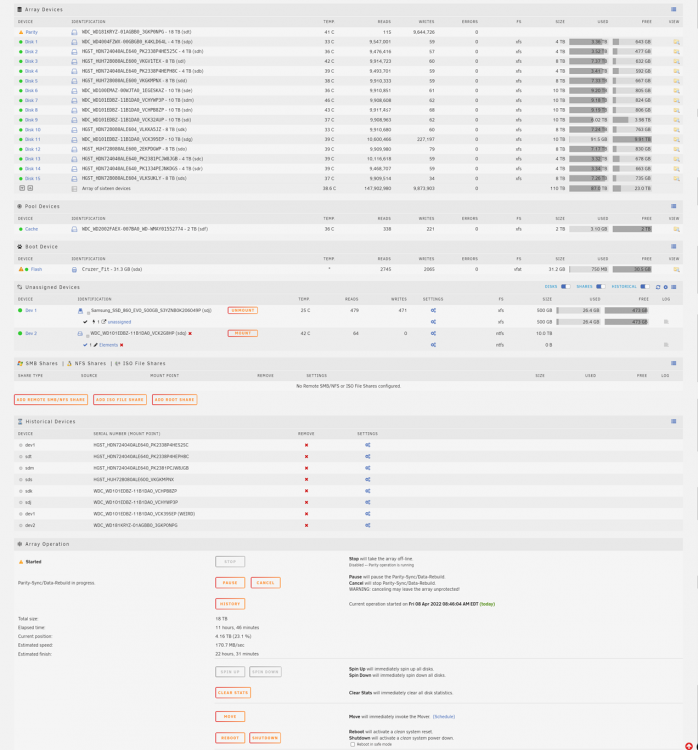
Before having a couple drives blow up on me and ports go bad I finally received my final parity drive. I went for the Western Digital Enterprise Gold model. I do think the parity build is going a little slow, or could that be a placebo affect since I haven't had to do a parity in such a long time. Do you think the speed at 166MB/sec is a little slow? Anyway I do think that WD RED PRO drive is the same drive as WD Gold drive. WD is large enough to handle multiple skus for the same product, easy for them.
-
Ripping full uncompressed and try to make my Plex server direct play and transcode was just a horrible option. I've just been using Plex less and less and opting for the Dune to get that excellent picture quality I'm looking for. Don't get me wrong, I'd love to use Plex's interface all the time, but not if I want to play just 10Mbps movies.
-
I'll be happy to try this.
-
I don't get all excited about jazzy eye candy, except the movie content itself. I'm 52 years old. I've had every media player and iteration there ever was. The processing power in those little boxes always have been behind. NOW, today, I can finally say I can play all Lord of the Rings movies using their intended rate. Achieavble only using my Dune player because of the onboard processing power. My Roku, and Apple TV wouldn't be able to do it, nor even start the beginning of the movie. That's why I'm having this little test, having another user try out one of the movies I have that can only be played with my Dune via file manager type access. If you read above you'll see that I only use Dune as a file manager type player and that's it. Scroll to the content I want to watch and press enter.
-
I have the TURBO WRITE plugin installed and right now turned on. I also have my disk settings on RECONSTRUCT WRITE. Are they conflicting each other? My server is up 24/7. Is it a good or bad idea to have both these options on?
-
Awesome, I'd love to play around since there was always that %0.00001 that it was my entire network. If you can play the file I'm compressing for you over your network, awesome! Since it is in a file form, how would you play it with your Apple TV? Do they even have the capability to play media files with a file manager type interface?
-
By the way, have you seen the latest Dune firmware? They have incorporated APPS like Netflix, HBOMAX, DISNEY, PLEX, and a nice new way to present it. Looks like they took a visual copy off of the Nvidia shield. The shield is my next best player. It usually can play high bitrate content via Plex with no pausing or artifacts. You just can't bog it down with APPS and games. I had to factory reset mine a few times, wanted to see what it would take to just make it not work. After a few crappy APPS it got slower and slower. But I do have to say Nvidia is $200 or more, so players in that price range are the only ones going to be able to do anything. An $80 Roku just isn't going to cut it. I think while this movie is compressing I'll plug in one of my Apple TV's'. Maybe a nice new firmware.
-
That's why I indicated the only thing the Dune is good for is just to play individual high bitrate files. I've went your route. Ordered 2 of the newer versions of the Apple TV 4k models. I was really hoping I was going to be set. Unfortunately there was no way for me to access my media on my server as like with a file manager so I can just pick and choose what I wanted to play. When trying to play with Plex, it would once again, only play low bitrate files. Plus it also didn't have several audio profiles that we all love. DTS! If I increase the rate to over 20, forget it. The Apple TV would mostly pause and force me to power cycle it. I'll tell you what, let me squeeze one of my movies and put it in my OneDrive share. I'll give you access to grab it. I'll record myself playing that file with my Dune player. Just for testing purposes I want to see if you are able to play this same file with your Apple TV 4K. Heck, maybe all this time I'm doing something wrong or missing something. I kind of would love to be proved wrong so maybe I can start using other media player I spent all this money on. I'll come back with the link for you. I've tried to do this with about 15 people and for some odd reason everyone tells me they are too busy or just don't want to. Anyway, I do hope you have the time.


