






1812
Members
-
Joined
-
Last visited
Everything posted by 1812
-
Tested this with a little gtx710 tonight in a browser and it worked! Now I just have to figure out how to make Emby apps use the Jellyfin server.... they keep telling me the Jellyfin server needs an update and then won’t do anything.I'm not directly answering your question, but why that? seems very expensive. I am in the process of moving from an md1000 hooked up to a z420 to moving the disks into a converted fractal R5: Go from the hba in the server out to an 8088 to 8087 adapter (https://www.amazon.com/gp/product/B00PRXOQFA/ref=ppx_yo_dt_b_asin_title_o00_s00?ie=UTF8&psc=1) 2 cables then into another of the same adapter, then breakout cables from the adapter to the drives (gives me 8 sata cables for the 8 drives.) add in a small 400 watt power supply I have laying around and its done. If I want to add more drives in the future, I can use an sas expander and add a drive cage with fans.it's been a while since I've passed an entire ssd to an osx vm. It would just depend on how macOS sees the drive. If it reads it w/out the quemu arg and other bits then you can check if trim is enabled or not (which I think for aftermarket drives you have to force enable anyways.) if its not recognized as an ssd, I don't know why it would not work, but again, I haven't tested it. I may have to do that just to see how it sees the disk.I'm no expert, but yes, and it "takes out the trash" when you delete a file, vs not really deleting the file, requiring deletion next time the "drive" attempts to write to those blocks, causing degraded performance while the write function waits. And additionally, over time, the lack of trash collection always seems to slow my disk image files after about 4-6 months of use. Which makes sense because if macOS thinks its a rotational disk, the data remains after deletion but is just blind to the os, essentially filling up the image. and when the data actually hits the ssd, having to deal with all the existing occupied blocks causes excessive overhead on ssd operations to perform basic functions that involve writes. along with the discard=unmap in the xml, yes is should, , which releases the removed blocks back to the ssd, vs having a static mapped section that may be going unused in the vm. better wear-leveling, meaning it's not writing to the same section over and over and over and over, where the image resides, causing premature failure of those blocks/sectors. there may be others as well.enable trim on disk images hosted on SSDs:Tested on High Sierra and Mojave I've been looking off and on about how to enable trim support on a disk image in osx. Had a few more minutes today and found it on the Internet (https://serverfault.com/questions/876467/how-to-add-virtual-storage-as-ssd-in-kvm) Issue: QEMU disks in osx are presented to the OS in a manner which interprets them as a rotational disk, as shown under About This Mac>System Report>SATA/SATA EXPRESS. Even after forcing trim on all disks via terminal, trim does not work, or even show it as an option. The result is the OS slows over time and disk images bloat. To correct: FOR 6.9.2 and below (if you're worried about potential loss of data, borking a working vm, or other world ending scenarios, make a backup before doing this, and proceed at your own risk.) With the VM shutdown, edit xml settings, changing the disk image info from <disk type='file' device='disk'> <driver name='qemu' type='raw' cache='writeback'/> <source file='/mnt/disks/K/G/vdisk.img'/> <target dev='hda' bus='sata'/> <address type='drive' controller='0' bus='0' target='0' unit='0'/> to <disk type='file' device='disk'> <driver name='qemu' type='raw' cache='none' io='native' discard='unmap'/> <source file='/mnt/disks/K/G/vdisk.img'/> <target dev='hda' bus='sata'/> <address type='drive' controller='0' bus='0' target='0' unit='0'/> with the changes only happening on the second line. (note: it may be possible to leave cache on write back and not use the io native setting, but I didn't experiment much, just followed working directions on the link) make this change for any disk images you have that the vm uses. next scroll to the bottom of the xml and add the following in the QEMU arguments <qemu:commandline> <qemu:arg value='-set'/> <qemu:arg value='device.sata0-0-0.rotation_rate=1'/> </qemu:commandline> any other arguments you have will also still need to be included. I do not know if order matters, but mine is at the end of the arguments list. if you have any other drives, add an additional copy of the argument (both lines) and modify the "device.sata0-0-0.rotat...." accordingly to match your address type listed at the top with the disk image(s). If you only have one, then you can leave it as is, assuming you didn't change the address. If you did this correctly, the vm will boot normally. But this time will display: Recognized as an SSD but no trim support. To fix this, you must force trim on all drives. To do this, go to terminal and enter: sudo trimforce enable It will then give you some text that makes it seem like your computer will eat itself. The OS will then sit for a short bit, after which time it will reboot itself. After it restarts, to verify trim support is now enabled, go back to About This Mac>System Report>SATA/SATA EXPRESS. 6.10.0 RC1 and up Enjoy!
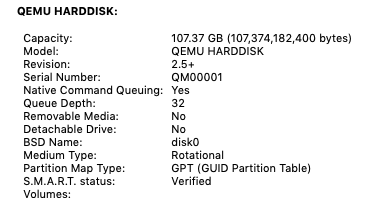
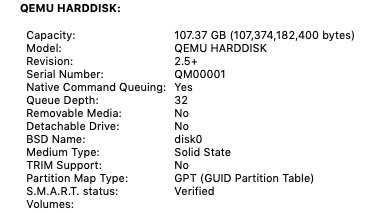
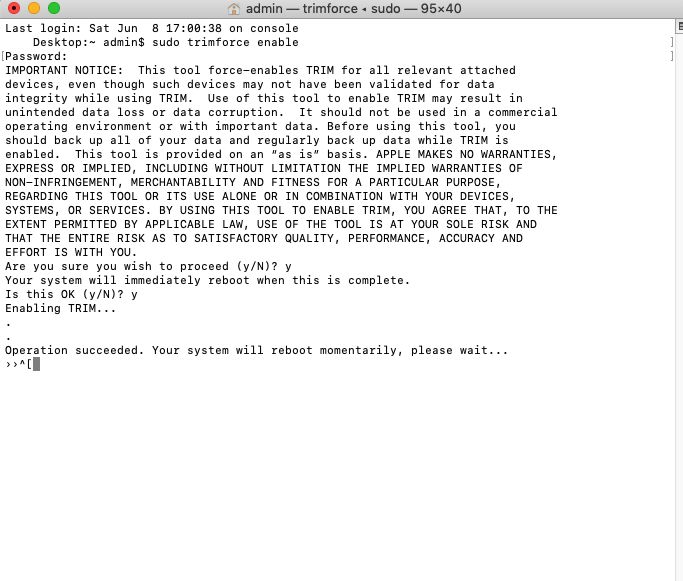
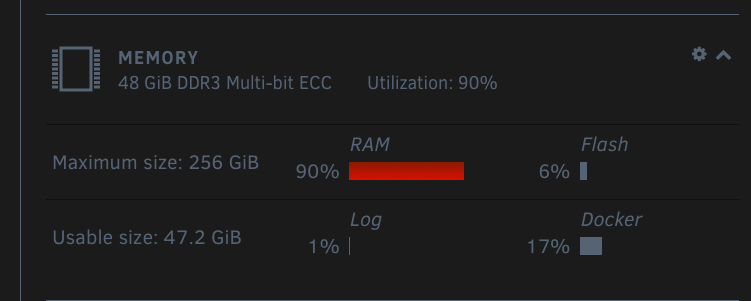
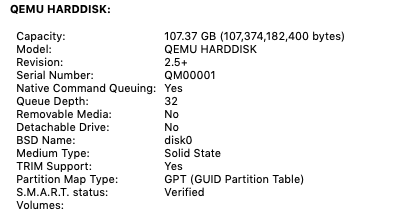 Multiple cache pools has been something many have asked to be developed for quite a while now....this is true. With no compression/encryption, just straight file backup local, the max I see is about 85-95MBps on large files (like a movie.) One way to help is increase thread count and chunk size. I run 20MBLooks to be a problem with how it is reading your hardware: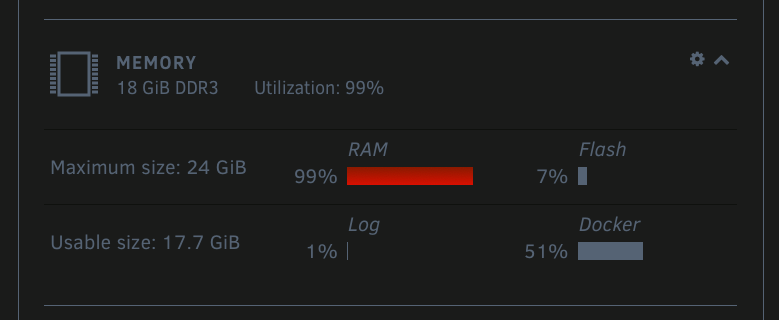
 Would be easier to implement as a set of toggles like acs override. -----edit I modified my 6.7.0 syslinux.cfg to include the appropriate text from above. System appears to be normal and the "vulnerable" status is shown in terminal. I didn't benchmark anything because I'm lazy.What about toggles like for acs override?I would be interested in this, right after multiple cache pools and arrays!thread hijack: I upgraded one of my servers to 6.7.0 today and received a message from fix common problems that my cache (dual ssd mirror) and 2 enterprise drives had their cache off. I input the command above for each and they enabled and I saw fast speeds like I haven't had before on the server cache drive(s). So why does this happen? and is the command above persistent or needs to be applied at reboot?updated the hp ml30 g9. seems functional but I don't recall having the following warnings in 6.6.7 (but they could have been there): May 14 10:33:07 Tower kernel: ACPI: Early table checksum verification disabled May 14 10:33:07 Tower kernel: Warning: node 0 [mem 0x00000000-0x7bffffff] overlaps with itself [mem 0x00100000-0x4a614fff] May 14 10:33:07 Tower kernel: pci 0000:03:00.0: BAR 6: failed to assign [mem size 0x00100000 pref] May 14 10:33:07 Tower kernel: pci 0000:09:00.0: BAR 6: failed to assign [mem size 0x00100000 pref] the two devices with failed memory are IOMMU group 1: [8086:1901] 00:01.0 PCI bridge: Intel Corporation Xeon E3-1200 v5/E3-1500 v5/6th Gen Core Processor PCIe Controller (x16) (rev 07) [1000:0072] 03:00.0 Serial Attached SCSI controller: Broadcom / LSI SAS2008 PCI-Express Fusion-MPT SAS-2 [Falcon] (rev 03) IOMMU group 11: [15b3:6750] 09:00.0 Ethernet controller: Mellanox Technologies MT26448 [ConnectX EN 10GigE, PCIe 2.0 5GT/s] (rev b0) But both appear to be functioning. Anything to worry about?Total sarcasm in my previous post. But there is no need to throw the baby out with the bathwater as you suggest. The above is is your view/opinion on user experience and not necessarily indicative of total user behavior. If you're using icons only as a metric and determining factor for what system information is available "underneath", then the icons we have as descriptors fail miserably in that job. Nerdpack uses a dropbox icon. Stats settings has the same icon as stats in the tabs. Backup/Restore is a shield but not antivirus. And why? These aren't stop signs or traffic lights, these are visual enhancements made to make the web GUI look nicer, which I think they do. These are not apps on your phone. Want further proof? Take the text away from the tabs and leave icons only. The settings icon takes a bit to understand, as well as plugins. Docker is fine, but what is that calendar icon? Oh, it's the apps... On the settings page, both the scheduler and auto update applications are refresh/reload circles, but which one is bolder? Can you tell me without looking? And why is the scheduler not a calendar (like the apps store icon is.) See. It's not about app icons like on your phone. It's all about the text with a little graphic element beside it only for the purpose of differentiation, not identification. And that is where your beef comes from (imo) not understanding the functions of the icons. This is not a swipe at all the UI icon changes or work that goes into it, I actually have no problem with the choices however much a stretch they are (or how colorful or lack of colorful they are) because they are essentially eye candy for the text descriptors. And we know this because I'm 100% certain you haven't memorized all the icons and their meanings and settings they link to, like the apps on your phone. To offer a contrasting user experience, I never look at the icons as a guide to settings/functions. I either scan the page visually or in a pinch, use control/command F and search for the text on the page of what I want. (I don't know why I wrote so much on this, I don't really care that much as long as the interface works. But looking nice is a bonus and I am appreciative of the work that goes into it. Regardless of your response, I won't be continuing this discussion further as I'm sure you will disagree with me 100%, and that's fine too I guess.)We could solve all these icon color change/problems if we had some sort of accompanying text descriptor by the icons themselves, so you'd know what you're clicking on....10gbe is "suppose" to work with the vmxnet3 virtual interface but falls laughably short in both high Sierra and Mojave. It also has some weird issues with upload speeds to some websites. My discover and ultimate disappointment are here: I do run a solar flare 10gbe card passed through with no issues on high Sierra (haven't tried Mojave with it due to nvidia driver unavailability with that vm's gpu). iPerf shows 9.1-9.5Gbps to my server from the vm.Either I'm a glutton for punishment or just cheap, but I've purchased another Mikrotik switch, the 4 10gbe port (+1 1gig port) little guy. For a refresher, my previous. less than stellar mikrotik experience is detailed here: You don't have to read this reasoning of why I bought this: OK, so the reason I bought this little switch is because my main, old, Cisco/linksys 24 port switch died a pathetic death. I was using the mikrotik CSS326-24G-2S+RM 24 port switch by my servers to bridge 2 10gbe connections between them (one for the main server, the other for a video editing vm on another.) And yes, I know I could do direct cabling (which I've done), but then the other devices on the network trying to access the server would be bottlenecked by a single gigabit connection. When my house switch died, I decided to move the CSS326-24G-2S+RM 24 gig/2 10gbe switch into it's place. I thought about getting Mikrotik's new 8 ports sfp+ switch, but really I didn't need that many ports in that configuration by my servers. So I ended up with the smaller 4 port 10gbe switch which made more sense. Actual review/experience: There isn't a lot of info about this switch out there aside a couple videos, including one review with a guy drinking beer, one with guy with a dry erase board, and some cell phone video of someone else rambling. So I felt like I was winging it a bit but understood what it should be capable of doing. I had the same issues with just getting into the switch as I described in the other review. Rather, I figured I'd have the same issues, so it was basically straightforward this time by following the steps I eventually figured out. Again, the documentation is lacking with the switch and even the website link they give you to get the full documentation doesn't work. The switch comes with dual boot software: RouterOs and SwitchOs, the former being the more powerful/configurable. After changing the IP to a static one on my network and rebooting, everything else was pretty straight forward: plug in the main server, plug in the video editing vm, add a gigabit cable for network access and done. Completely different experience than last time. Important to note: it only comes with 1 power adapter, but they promote the hell out of "dual power inputs for redundancy!" which makes you think you're getting two. You're not. I didn't. So, a bit disappointed about the Latvians having a better grasp on English and implied advertising tactics than me. I talked about the thinness of the metal chassis for the last switch. This one also has a metal chassis, and while it doesn't feel thin, it does feel "less expensive." What I mean is, that I have a Netgear Prosafe GS105 5 port gigabit switch, which feels more rugged, durable, and also weighs more (go figure) than the mikrotik switch. It's not that the mikrotik switch feels cheap, I just thought it would feel, "more." Don't get me wrong, the fit/finish is more than acceptable, as everything seems to be aligned how it should be. I ran some speed tests and found that RouterOS was ever so slightly faster than SwitchOs by maybe 5%... who knows. I don't use or plan to use all the functionality with Router Os (also, I'm glad there is a safe mode), but I may in the future so I'll just let it run. On SMB file share from the ssd cache on the server to the ssd in the video editing vm I was getting 3-400MB/s throughput each way. iPerf3 also showed some nice numbers once I pushed up the thread count (as I had to do with the previous switch to get it's max bandwidth.) This is with no network tuning, right out the box, main server running a mellanox connectx2 into the switch via dac, then out via dac to a solarflare card. Additionally, monitoring the flow in the web gui of the switch showed peaks up to 9.7, but really, anything over 9gbps is just fine with me, and would be fine with you too. SO, I've had this switch for about 4 hours at this point. It seems to do the job nicely. In the next few months, I'll get two sfp+ rj45 10gbe transceivers and make a 10gbe trunk to the main house switch (I put in cat6a about a year ago.) The remaining sfp+ port will be connected to my server that hosts the video ending vm because.... why not, it's there. If my experience changes with this switch, I'll update accordingly. Also, if mikrotik is reading this, and you want to send me a 24 port sfp+ switch with all rj45 10gbe transceivers (or 3 of those 8 port sfp+ switches with transceivers), I'll make it my main house switch and review it for you! ------- March 28, 2020 update So I've been using this constantly for about 11 months. I've dropped it, I've pushed it, I've switched back and forth between the operating systems. It just does what it needs to do. It runs very warm, always has. But it hasn't slowed down. Earlier today I made the decision based on it's location to add a heatsink to the top to help dissipate cooling a little more (ordered one off amazon.) Wasn't my idea as I saw it somewhere else. Does it need it, probably not, but it won't hurt especially since the device has a single heatsink inside that sort of touches the chassis, and then using that to help dissipate heat. I currently use all 4 of the sfp+ ports: 1 to my main server via, 1 to my backup server via dac, 1 to my workstation vm via dac, and one using an rj45 transceiver from fs.com running over cat6a to the 24-gigabit/2-sfp+ switch server as a trunk. That transceiver runs really hot, hotter than the chassis of the switch. But both are always within spec. Regardless, I order a mixed mini-heat sink kit as well for 7 bucks and will add one or two to that transceiver just for fun. Still no world from mikrotik on review sample 24 port sfp+ switch filled with rj45 10gbe transceivers..... but at the rate they are moving products, I doubt it will ever come at this point..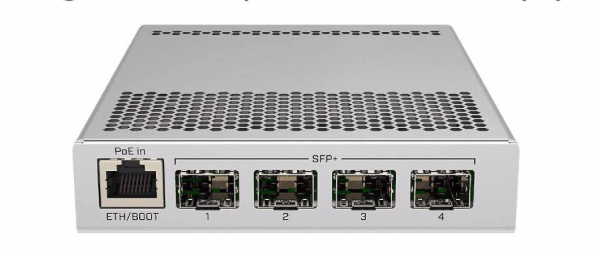

 might help if you tagged someone who would know... like... @limetech @jonpI concur 100%. I've seen a benefit on my vm's using Q35.OS X can be finicky with onboard. Additionally if you don’t have isolated cores, it can introduce audio issues.I actually deleted and reinstalled. If it happens again I’ll post diags but my last uptime was 50 something days so it could be a while...any reason it takes nearly 5 minutes to load? eb 25 17:55:21 Brahms1 emhttpd: Starting Recycle Bin... Feb 25 17:59:16 Brahms1 unassigned.devices: Mounting 'Auto Mount' Devices... or is it taking nearly 5 minutes to start mounting the devices via unassigned drives??This part below. First section is the video component, second is sound. Your address domain and pci domains will be different based on server configuration and card placement. <hostdev mode='subsystem' type='pci' managed='yes'> <driver name='vfio'/> <source> <address domain='0x0000' bus='0x0f' slot='0x00' function='0x0'/> </source> <address type='pci' domain='0x0000' bus='0x04' slot='0x00' function='0x0'/> </hostdev> <hostdev mode='subsystem' type='pci' managed='yes'> <driver name='vfio'/> <source> <address domain='0x0000' bus='0x0f' slot='0x00' function='0x1'/> </source> <address type='pci' domain='0x0000' bus='0x05' slot='0x00' function='0x0'/> </hostdev> W eything works until you change to the gpu, so do this: make a new vm per the methods in the video (if you have a good backup img file then just start at that part of the video l where you modify the xml. Once it boots into vnc, shut it down. Now, create a new vm, Linux or whatever. Remove the hard drive option so it doesn’t create a disk, only 1 core 255mb ram, whatever, it’s notngojng to be started. Select your gpu and it’s sound card. Click save but don’t start. Edit that vm, and when in the edit screen, toggle to xml. Scroll down near the bottom, find the host dev tags, will look like above. Copy all of that. Then go to your macOS vm, edit, and then toggle to edit xml. Scroll down to the bottom. Find the tag <memballon model =‘ virtio’> Tag. You want to paste the hostdev info you copied above/ just before that. Now, in the part you just pasted, look for the lines <address type =‘pci’....../> there will be one in each hostdev section. Delete those (they will auto generate correctly on near start. you are now ready to save the xml and boot the vm. We’ll deal with vnc removal later, but this is how you can manually add the gpu with the correct xml generatedand not have unRaid screw up the custom edits required for macos.



