bmartino1
Members
-
Joined
-
Last visited
Everything posted by bmartino1
-
Anything that calls a script... This could be a mobile browser on the dash board, a script, unraid connect issues and errors, ud scrip auto mount. User script gone astray Dockers that wget/curl back from host to call... A unraid load issues with the monitor script for notify/syslog the script that loads the dash oards and refreshs... With out monitoring top/htop idk. You have to find the memory leak ... This would be more of a fix but idk unRAID default fast CGI option... optionally: request_terminate_timeout = 60s (so truly stuck ones get killed) Recommend to kill the stale and zombie childs...
-
please make your own general post next time. THank you fro a diag. you apear to have a bunch of sleeping fast-cgi calls stalled whcih hit the memory leak and a few error due to the unraid connect plugin... This is my analsis of your logs What the logs show (hard evidence) 1) php-fpm pool is repeatedly saturating at 50 childrenYour syslog shows 25 occurrences of: php-fpm ... [pool www] server reached max_children setting (50) spanning Dec 20 → Dec 25. And your top.txt snapshot shows ~48 php-fpm processes running at once at the time the diagnostics were captured (so you were right at the ceiling). Also, at least a couple of these happen immediately after WebGUI login, e.g.: Dec 24 12:32:01 ... Successful login user root from 192.168.30.35 Dec 24 12:32:02 ... php-fpm ... server reached max_children (50) That strongly suggests: loading the dashboard (and its background polling endpoints) triggers enough slow/stuck PHP work that the pool fills up. 2) Repeated nchan watchdog killsYour syslog also shows repeated: monitor_nchan: Stop running nchan processes on multiple days (Dec 21/22/23/24/25). nchan is what Unraid uses for “live updates”/streaming UI events. If nchan gets wedged (often because upstream requests stall), the watchdog kills it and restarts it. This pairs really well with a “webgui becomes sluggish/unresponsive + php-fpm children pile up” story. 3) A very strong culprit: USB/UAS storage errors + resets (blocking I/O)In syslog-previous.txt, when a 5TB WD drive in a SABRENT enclosure comes online, you get a burst of UAS + write I/O errors: scsi host5: uas Direct-Access SABRENT ... Disk: WDC_WD50EFRX... (sda) Then many: I/O error, dev sda, sector ... (WRITE) Sense Key : 0xb ASC=0x4b ASCQ=0x0 uas_eh_abort_handler ... inflight reset SuperSpeed USB device ... uas_eh_device_reset_handler ... success This is exactly the kind of thing that can stall processes waiting on disk, and the Unraid GUI does a lot of “query disks / SMART / mounts / shares” type work via PHP endpoints. If a PHP worker is blocked waiting on a disk op (or a plugin querying that disk), it doesn’t return, so you burn through children until you hit max_children. So even if you call it “memory leak,” the logs look more like: What I’d do first (highest ROI)A) Eliminate the USB/UAS problem firstIf that SABRENT+WD50 device is still in the picture: Unplug it and see if the php-fpm max_children events stop. If you need it connected: try a different cable/port/power path (USB power flakiness causes exactly this) and/or disable UAS for that enclosure (common fix). How to disable UAS (the right way): Plug the enclosure in and run: lsusb lsusb -t Identify the enclosure’s VID:PID (like aaaa:bbbb) Add a USB-storage quirk in your Syslinux append line: usb-storage.quirks=aaaa:bbbb:u Reboot. (Your diagnostics were captured after a reboot where that enclosure wasn’t present, so I can’t pull the VID:PID from this zip.) B) Temporarily disable likely “UI poller” plugins to reduce pressureGiven your plugin list, I’d test disabling (one at a time) to see if max_children stops: Dynamix Active Streams Dynamix System Stats Unassigned Devices (especially if it’s touching that USB disk / remote mounts) This is a quick way to confirm whether the “stuck requests” are coming from a plugin endpoint. How to pinpoint which PHP endpoint is eating children (so you can prove it)Right now the diagnostics don’t include nginx access logs or php-fpm slowlogs, so we can’t name the exact script. But you can make Unraid tell you: 1) Turn on php-fpm slowlog (captures stuck request backtraces + script names)On Unraid this is typically /etc/php-fpm.d/www.conf (runtime filesystem), so it won’t persist unless you reapply on boot. Add (or enable) something like: request_slowlog_timeout = 5s slowlog = /var/log/php-fpm.slow.log optionally: request_terminate_timeout = 60s (so truly stuck ones get killed) Then restart php-fpm and wait for the next incident. The slowlog will usually reveal which PHP file/plugin is hanging. 2) Check nginx access logs during an eventWhen you’re hitting max_children, run: tail -f /var/log/nginx/access.log tail -f /var/log/nginx/error.log You’ll often see one endpoint being hammered (or timing out) — e.g. a plugin page refresh endpoint. Quick mitigation (not the real fix, but keeps GUI alive)If you just raise pm.max_children, you may reduce symptoms but you’re also allowing more stuck workers, which can make the GUI feel “randomly dead” for longer if the root cause is blocking I/O. Better mitigations: fix/remove the USB/UAS problem add php-fpm pm.max_requests (recycles workers to mitigate real leaks) add slowlog + terminate timeout to prevent indefinite worker hostage situations
-
updates are followed via github 11 notes. https://github.com/11notes/docker-unifi a updated tag will become avilabe soon then theres testing. also see docker tags as 11notes is failry fast to make updates but its slow to come to unriad due to testing and verfications. https://hub.docker.com/r/11notes/unifi/tags you can edit the tempatle and chagne the repo to the new tag to test: example: docker pull 11notes/unifi:10.0.160-unraid change repo to 11notes/unifi:10.0.160-unraid to test new version. bleeding edge...
-
you can setup authoring mode and export the tempalte you made to xml. then ask someone like grtgoblin to host it on there repo.
-
that depends on how the networks are setup and used. bridge yes, host and custom br0 no. I've found that the default CA immich (Immage genious) install no longer has a web ui listed, but the cuda and others do... So I have to assume that the template was touched..
-
Encrypting your data | Unraid DocsEncrypting your drives in Unraid adds a strong layer of protection for sensitive data, helping to prevent unauthorized access if a drive is lost or stolen. Encryption is available for the %%array|arra See also:
-
A key file is made once you authenticate. That's another post on auto unlock and deletion of the key once unlocked that would force a reauthorizing file ... But when you were prompted for the code a file was made in ram on the unraid host that is removed upon reboot.
-
The hook script would be what I would recommend as I'm fairly sure it's a issue with the cards and reset but don't have good data to explain and share how to do a hook script to reset the card. There are other things that can be added to syslonux grub boot but the baod, CPU and gcard didn't warrant the need of they used the mod probe... The qumeu extra arguments fixe nvdia and other code 43. Turns off windows force ejection and set up windows to be ready forvieturaled passed hardware. Sometimes a reinstall is needed after these edits due to how Windows boot kere al sees devices. I would definitely recommend the hook script. Unless the CPU doesn't have onboard gpu the the syslonux stuff is not needed. And again the bios dump of a gcard is not needed to pass. That help emulate parts for some interaction. Not required for what they are trying to do. The issue still stems from the GPU not being marked as primary due to the default vnc/spice. As the concern is that the gcard is picking up that a virtual display is made and thus the full card is acting as if the full hardware is not passed... Not enough info to assist either way.
-
... tldr is petter as a maintained plugin... you would still have to monitor the applications yourself... It why i made this script for nertools to use shinji257 repo... https://forums.unraid.net/topic/178033-bmartino1-user-scripts/page/2/#findComment-1596096 root@OMV:~# cat /boot/config/plugins/un-get/sources.list https://mirrors.slackware.com/slackware/slackware64-current/slackware64/ current https://slackers.it/repository/slackware64-current/ conraid https://raw.githubusercontent.com/shinji257/unraid_pkgs/main/slackware64-current/ shinji257 root@OMV:~#
-
destructive mode is new to me where is the settign for it
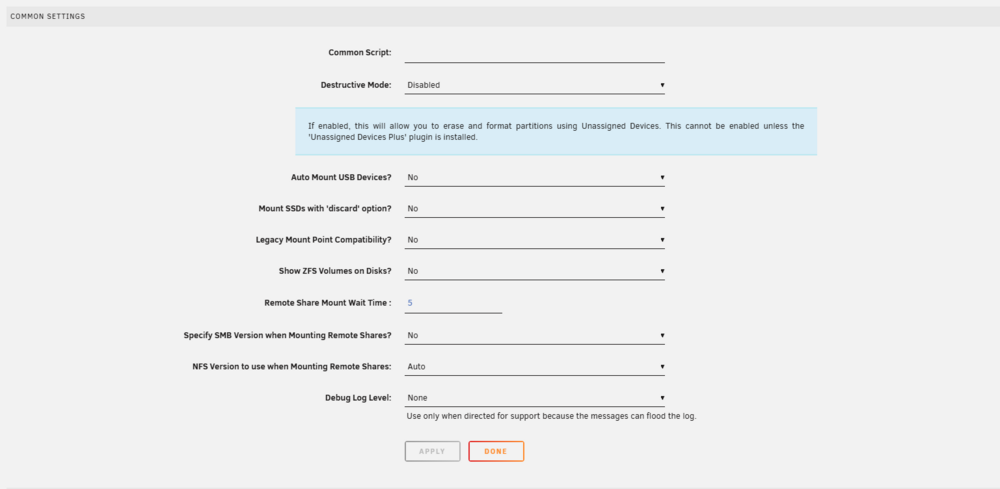
-
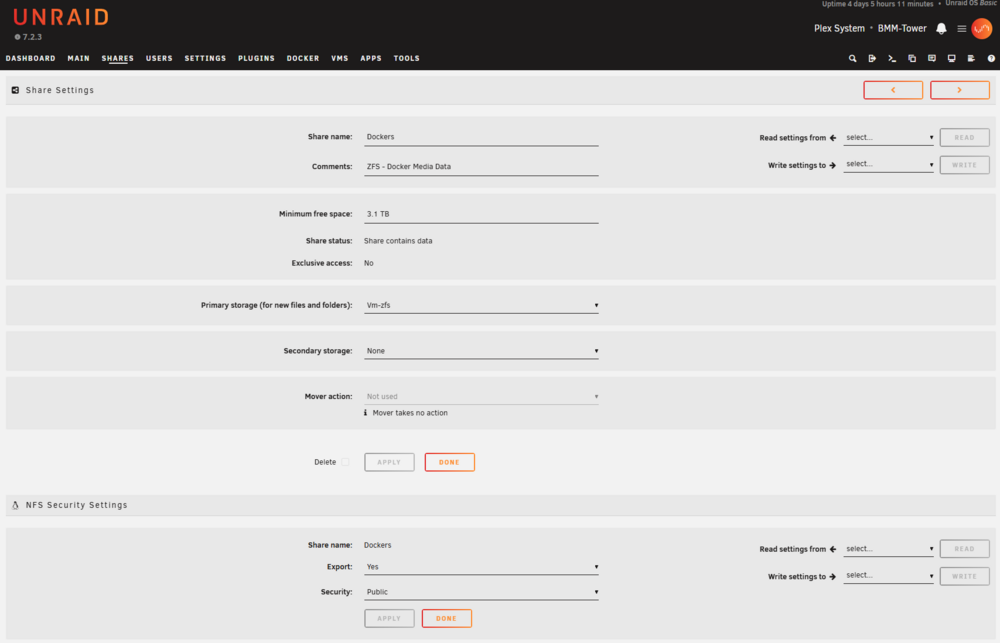
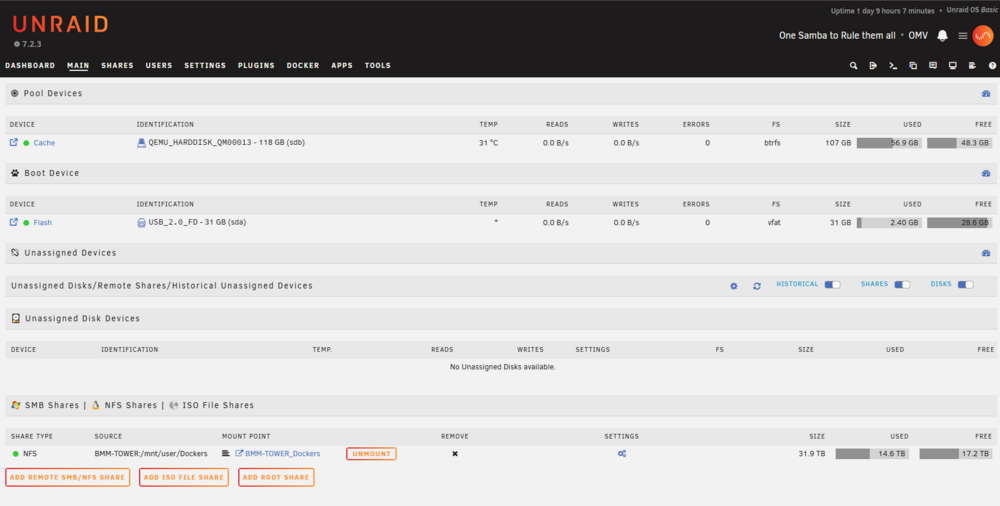
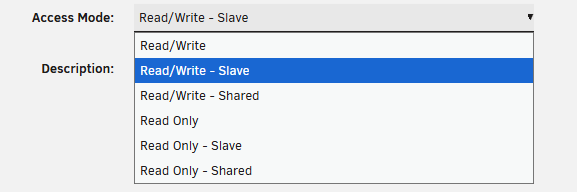
Correct via Unassigned disk. you would setup a share via NFS. and then connect to nfs via UD plugin to have a /mnt/remotes/Hostname_Sharename I have a media server plex instance and other as a separate unraid bare metal instance. the plex unraid system shares its docker folder: In my other unraid system Via UD in my unraid VM test instance... and now my OMV unraid instance can interact with teh docker folder... This said I recommend using FCP (Fix Common Problems) plugin) as you will need to set access edits if interacting with a remote share via another unraid docker. FCP will war go over and help you correct proper remote access and interaction with docker and remote connections.

-
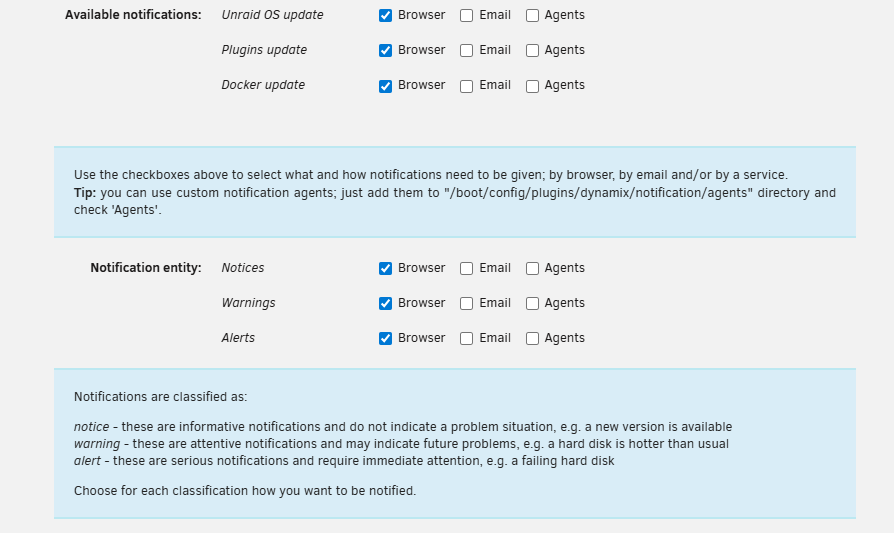
otherwise as i'm still tsting thigns with unraid and agents. I think it wounldn't be to hard to interact with teh agents. /boot/config/plugins/dynamix/notifications/agents/syslog.sh #!/bin/bash # Dynamix notification → local syslog agent case "$IMPORTANCE" in alert) PRIO="daemon.err" ;; warning) PRIO="daemon.warning" ;; *) PRIO="daemon.notice" ;; esac logger -p "$PRIO" -t unraid-notify \ "event=\"$EVENT\" subject=\"$SUBJECT\" desc=\"$DESCRIPTION\" msg=\"$CONTENT\" link=\"$LINK\"" To make a agent ... per squid example work flow: https://github.com/Squidly271/Wxwork-sample data per squid: https://docs.unraid.net/unraid-os/release-notes/7.0.0/#notification-agents as I think jsut makeing hte script here will auto run with teh agents check marks... I would have to tes this and report back...
-
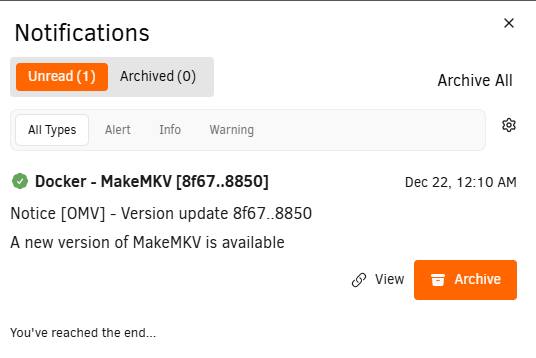
using this user scirpt i now have my unread notfi message sent to archive and added to syslog root@OMV:/tmp/notifications# ls archive/ Docker___MakeMKV_8f67..8850_ticket.notify root@OMV:/tmp/notifications# so this is a user scirpt that could be added ot teh notify script to implemnt this wanted interaction of adding notify/notfication into the syslog... something we can try and request to add to the notify script /usr/local/emhttp/webGui/scripts/notify no agent needed...

-
I could see a user script pulling the archived / saved notify messages, the data that would get piped to syslog. If I'm understanding you, you want the syslog to also show a unraid notification and its data in the syslog itself: After tracking it down... as a reboot clears theses notfications... Unraid has a emhttp monitor script and ini files that runs the notfiy script. as we can leverag the notfication scrip tto make a unraid notficaiton... It was then track down where notify saves the unread and archived messages.. root@OMV:/var/local/emhttp# cd /tmp/notifications root@OMV:/tmp/notifications# ls archive/ unread/ root@OMV:/tmp/notifications# cd unread/ root@OMV:/tmp/notifications/unread# ls Docker___MakeMKV_8f67..8850_ticket.notify root@OMV:/tmp/notifications/unread# cat Docker___MakeMKV_8f67..8850_ticket.notify timestamp=1766383803 event="Docker - MakeMKV [8f67..8850]" subject="Notice [OMV] - Version update 8f67..8850" description="A new version of MakeMKV is available" importance="normal" link="/Docker" root@OMV:/tmp/notifications/unread# ... So, I will have to re dig at the docs as the agents and system was reworked a bit. as theses are saved until a reboot and I dont' see why they couldn't be also apedend or sent to syslog. More trying to remover the path where the txt files are saved. If i'm understanding your corectly now. as I could see a use case for this especial when diag and a syslog server is running to capture data... But a user script can be leveraged to move the unread items into syslog and put them in archive... #!/bin/bash NOTIFY_DIR="/tmp/notifications" UNREAD="$NOTIFY_DIR/unread" ARCHIVE="$NOTIFY_DIR/archive" [ -d "$UNREAD" ] || exit 0 for file in "$UNREAD"/*.notify; do [ -e "$file" ] || continue # Reset vars timestamp="" event="" subject="" description="" importance="" message="" link="" while IFS='=' read -r key val; do val="${val%\"}" val="${val#\"}" case "$key" in timestamp) timestamp="$val" ;; event) event="$val" ;; subject) subject="$val" ;; description) description="$val" ;; importance) importance="$val" ;; message) message="$val" ;; link) link="$val" ;; esac done < "$file" # Map importance → syslog priority case "$importance" in alert) prio="daemon.err" ;; warning) prio="daemon.warning" ;; *) prio="daemon.notice" ;; esac # Emit to syslog logger -p "$prio" -t unraid-notify \ "event=\"$event\" subject=\"$subject\" desc=\"$description\" msg=\"$message\" link=\"$link\"" # Move to archive mv -f "$file" "$ARCHIVE/" done
-
you have a few weirdness things here. I'm not sure the immich web server is launching correctly... your explanation for the lan network is a bit confusing. quote "Network IP is 192.168.0.17 for everything on this PC/unRAID setup" *I have to assume this is unraids ip. Usually when running immich in brdige mode We would expect the postgress and redis dockers to be in bridge as well. (Or idealy host mode!) IF 192.168.0.17 is NOT YOUR UNRAID IP! then your postgress connection is wrong. Imich is a mutifacted stack that depends on other dockers... your redis connection is bad. As explained in my guide. updates will break redis and this can and will casue docker instability... Redis is also dead bitnami was bought out and removed this form many repos... the repo that your calling to install redis is no more. You must use valkey... I can't confirm nor recomedn using redis via docker mods for a stable instalations... please delete teh docker mod and use valkey for redis here is a password protected version All I can say is review my guide to guarantee a stable working instance. https://forums.unraid.net/topic/193997-guide-immich-docker-setup-unraid-ca/ IDK what happened to teh tempate nor why the web ui is doing that. please reset this back to the default option of: http://[IP]:[PORT:8080]




-
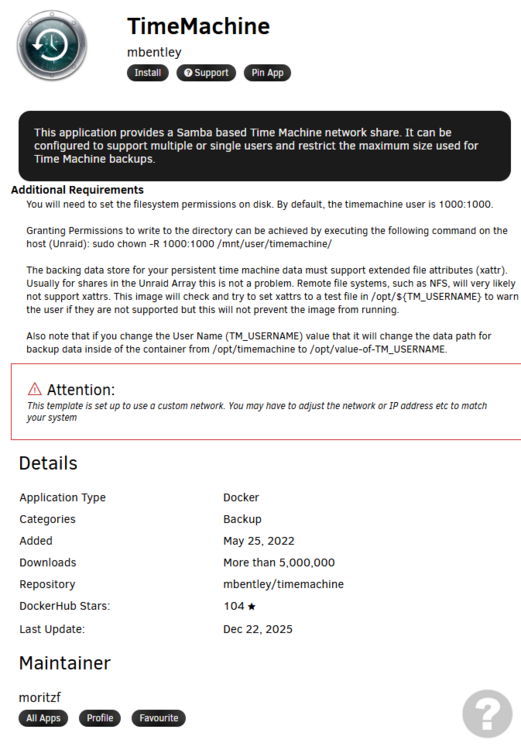
they are not required. They can assit zfs with time machine shares. Example ZFS passed into unraid for samba. root@pve:/data# zfs list NAME USED AVAIL REFER MOUNTPOINT VMs 103G 797G 96K /VMs VMs/pve 103G 797G 77.9G /VMs/pve data 2.07T 12.4T 67.8M /data data/Dockers 106G 12.4T 26.0G /data/Dockers data/PBS 19.6G 12.4T 19.6G /data/PBS data/PVE 168K 12.4T 104K /data/PVE data/TimeMachine 60.0G 12.4T 30.1G /data/TimeMachine data/Users 761G 12.4T 761G /data/Users data/samba 1.15T 12.4T 1.13T /data/samba root@pve:/data# zfs get xattr,dnodesize,recordsize,atime,case,acltype,aclinherit data/TimeMachine NAME PROPERTY VALUE SOURCE data/TimeMachine xattr on inherited from data data/TimeMachine dnodesize legacy default data/TimeMachine recordsize 128K default data/TimeMachine atime off inherited from data data/TimeMachine casesensitivity sensitive - data/TimeMachine acltype posix inherited from data data/TimeMachine aclinherit restricted default root@pve:/data# Where I could runn the above and imporve my zfs and apple time machine connections... I mentioned zfs extra options as that is whats recommend via samba linux team with zfs. There are a few guides via Google that go over it and it was worth a mention. Required no, helps yes. When users with default samba default unraid config have isseus its worth a try / test. other random google data on it as well: https://discussions.apple.com/thread/256112267?sortBy=rank https://github.com/jollyjinx/ZFS-TimeMachine Where most of that data came from: https://prafiles.in/using-zfs-for-timemachine/
-
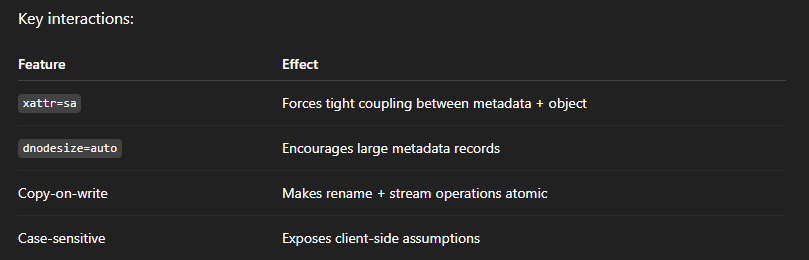
Sorry for the late replies... I was digging and waiting on some more info from the linux samba team... glad you found a solution. Some base stock samba info vfs objects = catia fruit streams_xattr fruit:metadata = stream fruit:resource = stream fruit:locking = none fruit:time machine = yes ea support = yes store dos attributes = yes This is textbook-correct bare min for stock samba: macOS ≥ Big Sur SMB-based Time Machine streams_xattr instead of netatalk... But To answer some of your questions... Samba 4.21.x + macOS Tahoe SMB client regressionmacOS Tahoe (26.x) tightened SMB2/3 create semantics for Time Machine: During sparsebundle creation, macOS now: Performs multiple parallel SMB CREATE requests Uses compound requests with durable handles Heavily stresses: NTCreateAndX extended attributes streams + locking state rename atomicity Unraid’s Samba path fails before file creation completes: This is a metadata handshake failure, not a storage failure. Unraid’s Samba is not “stock Samba”*This is critical. What I have found. Unraid: Injects wrapper logic Auto-generates smb.conf fragments Applies opinionated defaults Mixes: POSIX ACL translation user/group coercion share-level overrides Even when you use SMB Extras, Unraid still: Controls startup order Owns winbind behavior Manages mdns / avahi Applies internal permission normalization *Docker bypasses all of this. *This is a reason why I run my own smb config... ZFS makes the bug deterministicZfs is strict, and there are so,e other zfs settings that need to be set / watched... macOS expects AFP-like semantics emulated over SMB. When Samba’s fruit module almost matches expectations but fails one atomic metadata edge case → macOS aborts immediately. Some ZFS checks: zfs list asumed pool / datset is tank/TimeMachine Check current ZFS settings: zfs get xattr,dnodesize,recordsize,atime,case,acltype,aclinherit tank/TimeMachine Set required / recommended properties zfs set xattr=sa tank/TimeMachine *Only applies to new files. Existing files keep old layout. Dnode sizing (metadata-heavy workloads): zfs set dnodesize=auto tank/TimeMachine Case sensitivity (must be set at creation time) *(this is set at dataset creation...) check: zfs get case tank/TimeMachine how to set (zfs master or teminal): zfs create -o case=sensitive tank/TimeMachine ACL behavior (recommended for SMB/macOS): zfs set acltype=posixacl tank/TimeMachine zfs set aclinherit=passthrough tank/TimeMachine Check: zfs get acltype,aclinherit tank/TimeMachine RE verify: zfs get xattr,dnodesize,case,acltype,aclinherit,atime tank/TimeMachine expected ideal output: xattr sa dnodesize auto case sensitive acltype posixacl aclinherit passthrough atime off Why force user = root is NOT the issueThis gets blamed a lot. Incorrectly. You already proved: Multiple Macs Multiple NICs Multiple filesystems Same failure point If this were permissions: You’d see partial sparsebundle creation You’d see permission denied You’d see retries Instead you get instant abort. That’s protocol-level, not POSIX. @JorgeB Why Unraid specifically is at fault (not Samba in general) Same macOS + same Samba version works on: TrueNAS SCALE Linux + system Samba Dockerized Samba Fails on: Unraid native SMB This isolates the bug to: Not Samba upstream. Not ZFS. Not macOS alone. Unraids has a good implementation, just doesn't fit all use cases... there is no samba config option that can be implemented to easily address users issues on apple time machine. *I've even see this where a old time machine configuration break due to smb share config changes and it not be samba its go to the dam Apple delta time machine and reconnect! Similar to zfs snapshots. apple time machine are snapshots on apple hfs. It's entirely metadata to storage. Apple aborts if any degradation is detected to preserve the snapshot data. even when Apple makes a client connection to unraid and how unraids samba/avahi and settings handles CIFS is affected here. I did a deep dive with a another person on the forum with apple and rsync. The underlying issues is in how apple clients connects. The docker just has a known working state which can be implemented on bare unraid. But yes, a Docker version of this is fine for a good soltuon for others. So to Recap Based on behavior, logs, and known Samba issues: This aligns with: Failure timing Docker success ZFS sensitivity Tahoe-only regressions
-
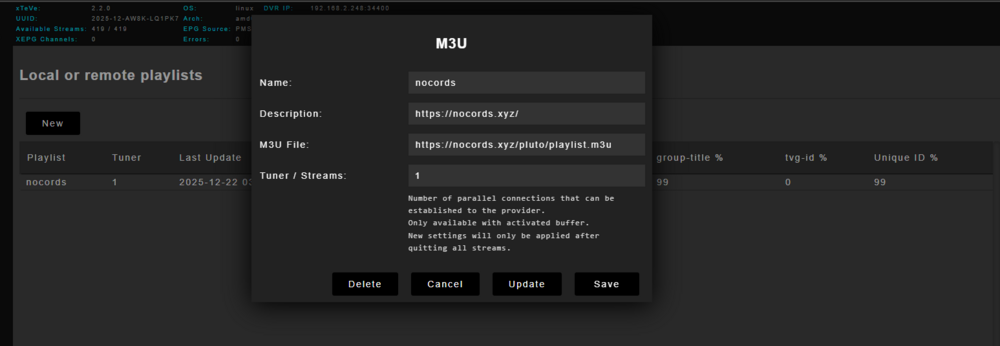
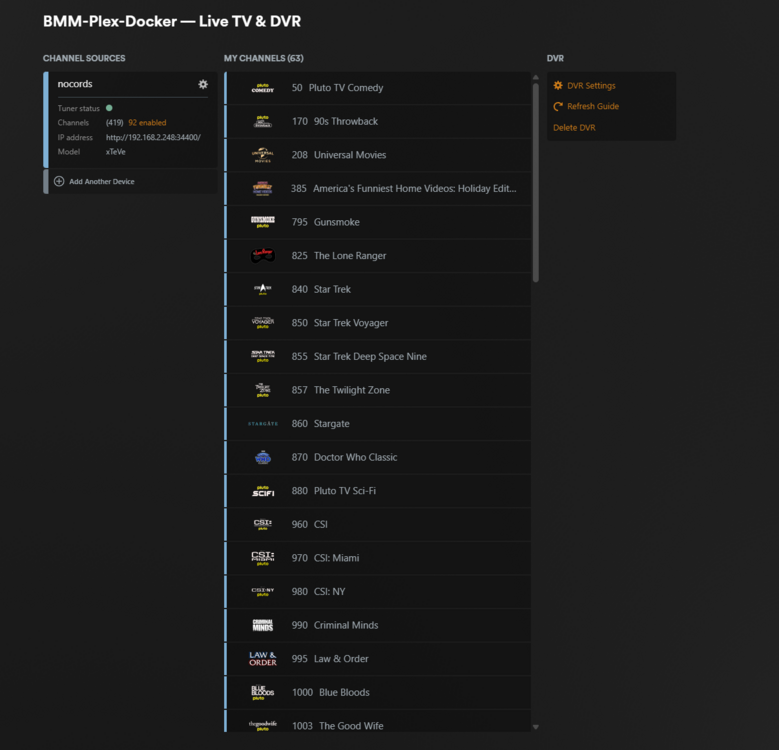
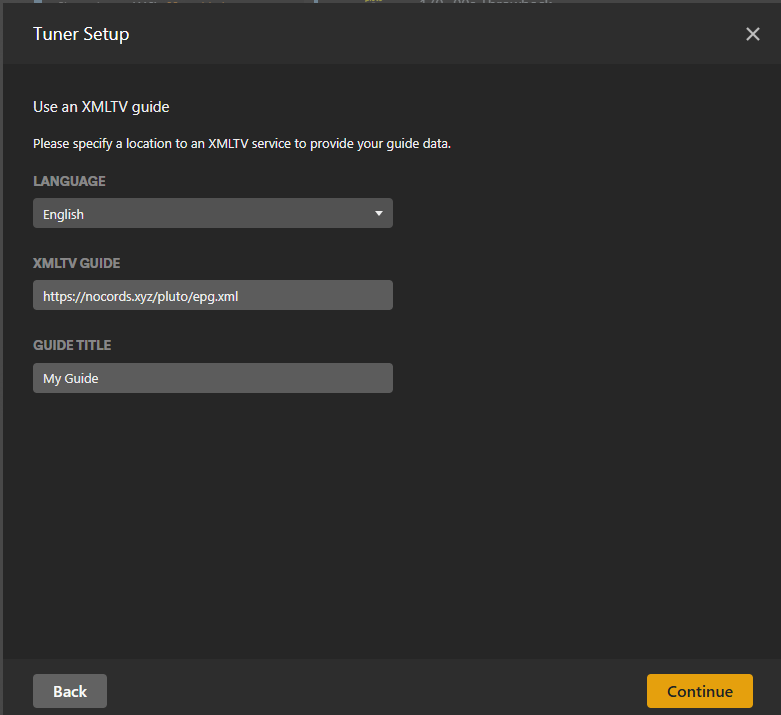
you can generate this with xteve: http://<your IP of XTEVE>:34400/xmltv/xteve.xml *Programmed inside xteve with filters... plex needs the xml file, I usually use no cords for USA English. USA - English Pluto https://nocords.xyz/ when plex asks for a guide use the xml: https://nocords.xyz/pluto/epg.xml example nocords: xteve playlist: plex add tuner: ################################################################################### Its why I shared the Legal Free IPTV: https://github.com/Free-TV/IPTV the guides and playlist. INFO Playlist info of content: https://github.com/Free-TV/IPTV/blob/master/lists/italy.md Xteve the file to grab: https://raw.githubusercontent.com/Free-TV/IPTV/refs/heads/master/playlists/playlist_italy.m3u8 For Plex:. Example for all the egp xml GUIDE DATA: https://github.com/Free-TV/IPTV/blob/master/epglist.txt XTEVE Italy xml https://epgshare01.online/epgshare01/epg_ripper_IT1.xml.gz
-
Has explained my original reply. As I also know the terminal commands and don't care that I'm using terminal and only bumped this because I thought it'd be nice to actually have a button that would do this.. I essentially just need to run three commands ... This would entail me run-in umount commands, clear commands, partd commands, make.fs commands... etc etc..
-
Preclrar doent do the format correctly for other disks. I have tried preclrar that and aom some I don't want the parity wrote of zero being added .. Again I want a single disk part clean which is fast. This has to do with clearing down flags got and setup used disk for reinitializing on other systems...
-
No UD gives me mount... I still have to run commands to clear a disk via terminal... I want a button with a warning that clears the disk. Similar to running windows diskpart clean UD give me a udev like rule for a script to run per the US device.. I just want a nicer button that runs the terminal commands to clean up disks for reuse (not on unraid)
-
the NPU is the New G-Card for matrix AI tasks. Alot of dockers, vms and host can use these for ai Computational work loads. there has been some chatter on the forum... some with intel, some with amd and some with ich777 anf the google Corel devices... https://forums.unraid.net/topic/193706-support-for-amd-ryzen-ai-9-hx-pro-370-w-radeon-890m-chip-thing/ example host driver for npu for AMD: https://github.com/amd/xdna-driver as somewhat explained here for intell. https://forums.unraid.net/topic/183499-intel-npu-drivers-installed/#findComment-1579038 and plugins for TPU variants... https://forums.unraid.net/topic/92865-support-ich777-amd-vendor-reset-coraltpu-hpsahba/
-
I would like to see this as a option in the unassigned disk for disk recovery and clearing for use else where. scenario I have a lazrus system. I plug in a Disk and use unasiged to mount and move the data I want off. I would like a way to clear the disk after wards... This would entail me run-in umount commands, clear commands, partd commands, make.fs commands... etc etc... when the unassigned disk could do this for me with a click of the button...
-
if all else fails the man pages are online format as well: https://linux.die.net/man/
-
so then its more on how to get groff to populate unraid manpages if unraid reboots... groff(1) General Commands Manual groff(1) Name groff - front end to the GNU roff document formatting system Synopsis groff [-abcCeEgGijklNpRsStUVXzZ] [-d ctext] [-d string=text] [-D fallback-encoding] [-f font-family] [-F font-directory] [-I inclusion- directory] [-K input-encoding] [-L spooler-argument] [-m macro-package] [-M macro-directory] [-n page-number] [-o page-list] [-P postprocessor-argument] [-r cnumeric-expression] [-r register=numeric-expression] [-T output-device] [-w warning-category] [-W warning-category] [file ...] groff -h groff --help groff -v [option ...] [file ...] groff --version [option ...] [file ...] Description groff is the primary front end to the GNU roff document formatting system. GNU roff is a typesetting system that reads plain text input files that include formatting commands to produce output in PostScript, PDF, HTML, DVI, or other formats, or for display to a terminal. Formatting commands can be low-level typesetting primitives, macros from a supplied package, or user-defined macros. All three approaches can be combined. If no file operands are specified, or if file is “-”, groff reads the standard input stream. A reimplementation and extension of the typesetter from AT&T Unix, groff is present on most POSIX systems owing to its long association with Unix manuals (including man pages). It and its predecessor are notable for their production of several best-selling software engi‐ neering texts. groff is capable of producing typographically sophisticated documents while consuming minimal system resources. The groff command orchestrates the execution of preprocessors, the transformation of input documents into a device-independent page de‐ scription language, and the production of output from that language. Options -h and --help display a usage message and exit. Because groff is intended to subsume most users' direct invocations of the troff(1) formatter, the two programs share a set of options. However, groff has some options that troff does not share, and others which groff interprets differently. At the same time, not all valid troff options can be given to groff. groff-specific options The following options either do not exist in GNU troff or are interpreted differently by groff. -D enc Set fallback input encoding used by preconv(1) to enc; implies -k.